- Sector-19, Fridabad-121002, Haryana, India
- +91 129 403 7300
- +91 971 759 0012
- Info@avnschoolfaridabad.com
AI in Education: Benefits, Challenges, and Opportunities for Students

How Schools in Faridabad Involve Parents in Student Learning: Building Strong Partnerships for Student Success
July 9, 2026
Can Artificial Intelligence Make Students Better Learners?
July 13, 2026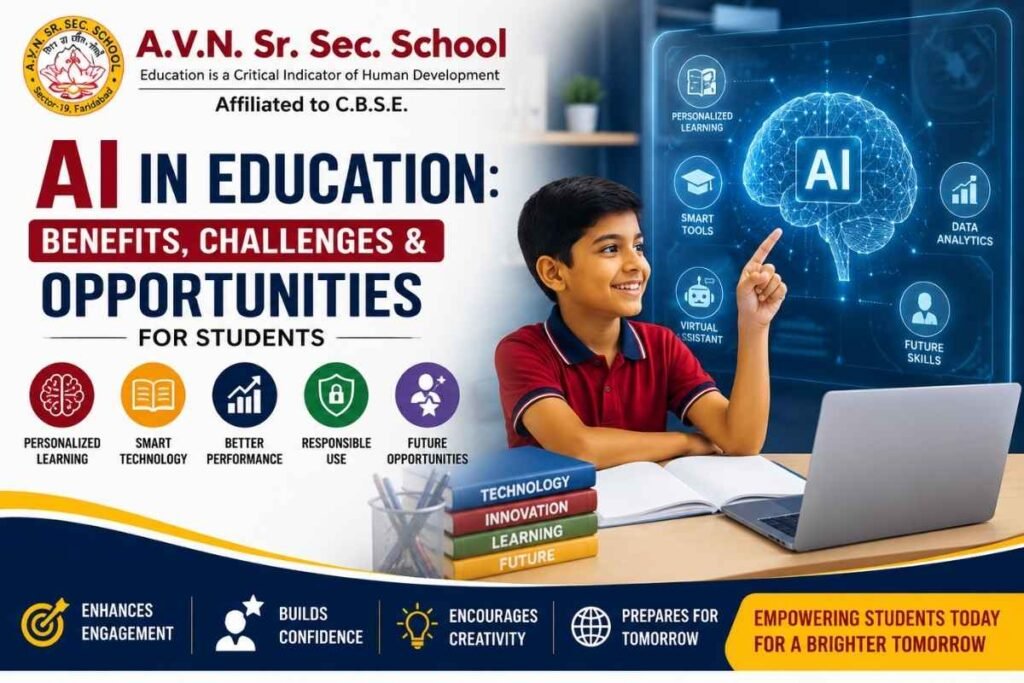
Artificial Intelligence (AI) is rapidly changing the way students learn, teachers teach, and schools operate. From personalized learning platforms to smart educational tools, AI is becoming an important part of modern education. As technology continues to evolve, students need to understand not only how to use AI but also how to use it responsibly and effectively.
The growing influence of AI in education is creating new opportunities for learning while also presenting certain challenges. Schools that embrace innovation while maintaining strong academic values are helping students prepare for a technology-driven future.
Parents looking for a future-focused learning environment often seek the <a href=”https://avnschoolfaridabad.com/best-school-for-kids-in-faridabad/”>Best School for Kids in Faridabad</a>, where students can develop both academic knowledge and essential life skills needed for tomorrow’s world.
Understanding AI in Education
Artificial Intelligence refers to technology that can perform tasks requiring human intelligence, such as learning, analyzing information, solving problems, and making recommendations.
In education, AI is commonly used through:
- Smart learning applications
- Online tutoring systems
- Educational chatbots
- Language learning platforms
- Personalized learning software
- Performance tracking tools
These technologies help students learn more efficiently and provide teachers with valuable insights into student progress.
Benefits of AI in Education
Personalized Learning Experience
One of the biggest advantages of AI is its ability to personalize education.
Every student learns differently. Some learn quickly, while others may need additional support. AI-powered learning platforms can analyze student performance and provide customized lessons based on individual learning needs.
This helps students:
- Learn at their own pace
- Strengthen weak areas
- Build confidence
- Improve overall understanding
Personalized learning creates a more engaging educational experience for students.
Better Access to Educational Resources
AI-powered tools make quality educational content available anytime and anywhere.
Students can access:
- Interactive lessons
- Video tutorials
- Practice exercises
- Instant feedback
- Digital learning materials
This flexibility helps students continue learning beyond the classroom.
Improved Student Engagement
Traditional teaching methods may not always capture every student’s attention. AI-based educational tools often include interactive features that make learning more enjoyable.
Gamified learning experiences, quizzes, and virtual learning assistants can increase student participation and motivation.
Faster Feedback and Assessment
AI tools can quickly evaluate assignments, quizzes, and practice tests.
Students receive immediate feedback, helping them:
- Identify mistakes
- Improve understanding
- Correct errors quickly
- Track progress regularly
This allows learners to continuously improve their performance.
Challenges of AI in Education
While AI offers many advantages, it also presents challenges that schools, teachers, and parents must address.
Overdependence on Technology
Students may become overly reliant on AI tools if they use them without proper guidance.
Technology should support learning, not replace independent thinking. Students must continue developing problem-solving and analytical skills on their own.
Accuracy and Reliability Issues
AI systems are not always correct. Sometimes they can provide inaccurate or incomplete information.
Students should be encouraged to:
- Verify facts
- Use trusted sources
- Think critically
- Ask questions
Critical thinking remains one of the most important skills in the digital age.
Privacy and Data Security Concerns
Many AI-powered platforms collect user data to improve learning experiences.
Schools and parents must ensure that educational tools:
- Protect student information
- Follow privacy regulations
- Maintain secure learning environments
Digital safety should always remain a priority.
Reduced Human Interaction
Learning is not only about acquiring knowledge. It also involves communication, teamwork, empathy, and emotional development.
Teachers play a vital role that technology cannot replace. AI should complement classroom instruction rather than substitute meaningful human interaction.
Opportunities AI Creates for Students
Preparing Students for Future Careers
AI is transforming industries worldwide, including healthcare, finance, engineering, marketing, and education.
Students who understand AI concepts today may find themselves better prepared for future careers.
Key future-ready skills include:
- Digital literacy
- Data interpretation
- Problem-solving
- Adaptability
- Communication
- Creativity
Educational institutions that focus on these skills help students remain competitive in an evolving job market.
Encouraging Innovation and Creativity
Contrary to common misconceptions, AI can support creativity when used correctly.
Students can use AI tools for:
- Brainstorming ideas
- Research assistance
- Creative projects
- Content organization
- Learning support
However, original thinking should always remain the foundation of learning.
Parents and educators can further support innovation by exploring strategies for encouraging creative thinking in students.
Building Adaptability Skills
Technology continues to evolve at an incredible pace. Students who learn how to adapt to new tools and environments will be better prepared for future challenges.
Adaptability helps students:
- Learn new technologies quickly
- Handle change confidently
- Develop resilience
- Embrace lifelong learning
Parents can learn more about this important skill through this guide on why adaptability matters for students today.
How Schools Can Use AI Responsibly
Schools have a responsibility to ensure that AI enhances learning without creating dependency.
Effective AI integration includes:
Teaching AI Awareness
Students should understand:
- What AI is
- How AI works
- Its limitations
- Responsible usage practices
For a deeper understanding, students and parents can explore this guide on AI for Children.
Maintaining a Balanced Learning Approach
Schools should combine:
- Traditional teaching methods
- Technology-enhanced learning
- Hands-on activities
- Collaborative projects
- Creative exercises
This balance supports both academic and personal development.
Promoting Digital Citizenship
Students should learn:
- Online safety practices
- Ethical technology use
- Information verification
- Responsible digital behavior
These lessons prepare students to navigate technology safely and responsibly.
The Role of Schools in the AI Era
Modern schools must prepare students for a future where technology and human skills work together.
A strong CBSE School in Faridabad focuses not only on academic excellence but also on building critical thinking, creativity, leadership, and digital awareness.
By combining innovation with strong educational values, schools can help students become confident learners and responsible technology users.
Parents interested in a holistic learning environment can explore the educational approach offered by AVN School, where academic growth is balanced with personal development and future-readiness.
Conclusion
Artificial Intelligence is transforming education in remarkable ways. It offers students personalized learning experiences, greater access to educational resources, faster feedback, and opportunities to develop future-ready skills. At the same time, challenges such as overdependence on technology, privacy concerns, and the need for critical thinking must be carefully addressed.
The future of education is not about replacing teachers with technology. It is about using AI as a powerful tool to support learning while continuing to nurture creativity, adaptability, communication, and independent thinking. When schools, teachers, and parents work together, AI can become a valuable partner in helping students achieve their full potential.