- Sector-19, Fridabad-121002, Haryana, India
- +91 129 403 7300
- +91 971 759 0012
- Info@avnschoolfaridabad.com

How to Encourage Creative Thinking in Students: Practical Strategies for Lifelong Learning and Success

Doctor’s Day Health Awareness Session with Dr. Prashant Bhatia
July 1, 2026
AI for Children: A Smart Parent’s Guide to Introducing Artificial Intelligence Safely, Responsibly, and Effectively
July 6, 2026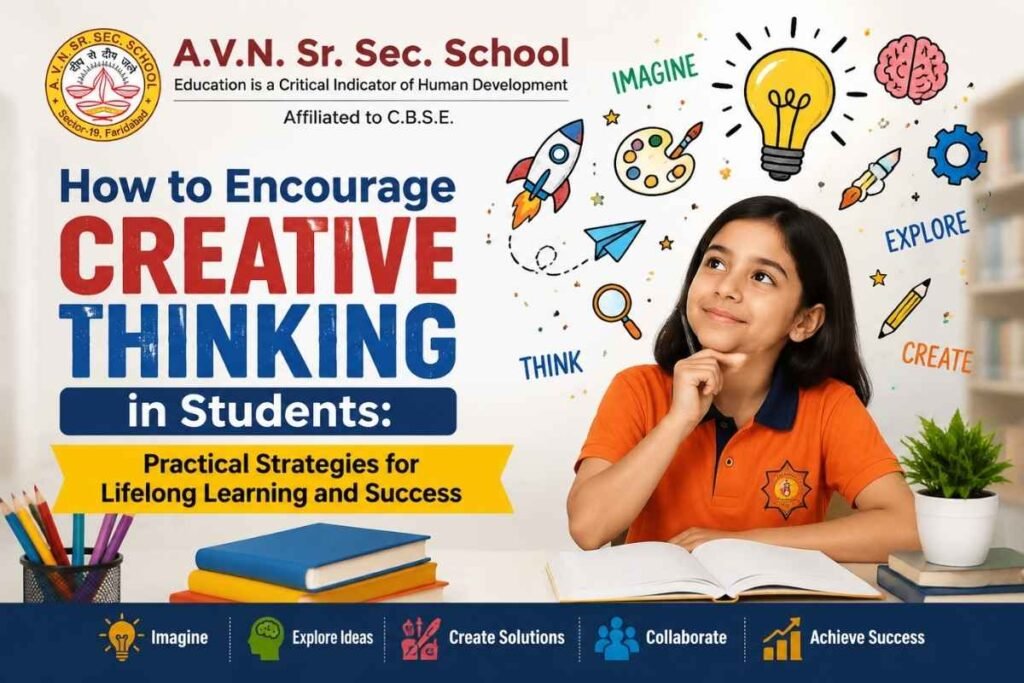
Creativity is one of the most valuable skills students can develop during their school years. In today’s fast-changing world, academic knowledge alone is not enough. Students also need the ability to think independently, solve problems, adapt to new situations, and generate innovative ideas. Creative thinking helps children become curious learners who are confident in exploring new concepts and finding practical solutions to everyday challenges.
Schools play a significant role in nurturing creativity because students spend a large part of their day in a learning environment. Teachers, classroom activities, and school culture all influence how students think and approach problems. By encouraging imagination, curiosity, and independent learning, schools prepare students not only for examinations but also for lifelong success.
What Is Creative Thinking?
Creative thinking is the ability to look at situations from different perspectives and develop original ideas or solutions. It is not limited to painting, music, or storytelling. Creativity can be applied in mathematics, science, technology, languages, and even daily decision-making.
Students with strong creative thinking skills are more likely to ask meaningful questions, analyze situations carefully, and explore multiple solutions before reaching a conclusion. These abilities help them become independent learners who are confident in facing new challenges.
Why Creativity Matters in Education
Modern education is shifting from memorizing information to applying knowledge in real-life situations. Employers and universities increasingly value skills such as innovation, collaboration, adaptability, and critical thinking. Creative students often develop these qualities naturally because they are encouraged to think beyond textbook answers.
Creativity also improves classroom engagement. Students who actively participate in discussions, projects, and hands-on activities usually understand concepts more deeply than those who rely only on rote learning. They enjoy learning because they become active participants rather than passive listeners.
Encourage Students to Ask Questions
Curiosity is the starting point of creativity. Every question a student asks opens the door to deeper understanding and exploration. Instead of simply providing answers, teachers can encourage students to investigate, discuss, and discover solutions independently.
Questions such as “Why does this happen?”, “What if we tried another method?” or “How could we improve this idea?” inspire analytical and creative thinking. Over time, students become comfortable exploring different possibilities rather than accepting information without reflection.
Make Learning Interactive
Interactive learning experiences naturally encourage creativity. Activities such as experiments, classroom debates, role-playing, educational games, and project-based learning allow students to apply concepts in practical ways.
For example, instead of memorizing scientific facts, students can conduct simple experiments and observe results themselves. Similarly, history lessons become more engaging when students recreate historical events or participate in discussions from different viewpoints.
Hands-on learning helps students connect knowledge with practical experiences, making learning both meaningful and memorable.
Create a Safe Environment for New Ideas
Students are more likely to think creatively when they know their ideas will be respected. Fear of making mistakes often prevents children from expressing original thoughts.
Teachers should encourage open discussions where every student feels comfortable sharing opinions without fear of criticism. Constructive feedback is far more effective than focusing only on mistakes. When students understand that errors are part of learning, they become more willing to experiment and innovate.
A positive classroom environment builds confidence, which is essential for creative thinking.
Encourage Reading Beyond Textbooks
Reading is one of the simplest ways to expand imagination. Books expose students to different cultures, perspectives, experiences, and ideas that they may never encounter in everyday life.
Schools can encourage students to read biographies, science magazines, fiction, history books, and educational articles alongside their regular curriculum. Diverse reading habits improve vocabulary, strengthen communication skills, and stimulate imagination.
Students who read widely often develop better problem-solving abilities because they learn to connect ideas from different subjects.
Integrate Arts and Creativity Across Subjects
Creative thinking should not be limited to art classes. Mathematics can include puzzle-solving activities, science can involve innovative experiments, and language classes can encourage storytelling and creative writing.
Art, music, drama, and craft activities also contribute significantly to cognitive development. These activities strengthen observation skills, emotional expression, and imagination while helping students develop confidence.
An integrated approach ensures creativity becomes part of everyday learning rather than an occasional activity.
Promote Collaboration and Teamwork
Group activities provide excellent opportunities for creative thinking. When students work together, they exchange ideas, learn from different perspectives, and discover solutions collectively.
Brainstorming sessions, collaborative projects, and classroom discussions teach students how to communicate effectively while respecting different opinions. These experiences also develop leadership, adaptability, and interpersonal skills that are valuable throughout life.
Collaboration demonstrates that creativity often grows stronger when ideas are shared.
Use Technology Responsibly
Technology offers students access to countless educational resources, creative design tools, coding platforms, and virtual learning experiences. Digital presentations, educational videos, animation software, and online research can all encourage innovative thinking.
However, technology should support learning rather than replace active participation. Students should also spend time solving problems through discussion, observation, reading, and practical activities. Maintaining a healthy balance helps develop both digital literacy and independent thinking.
Give Students Opportunities to Solve Real Problems
Real-world problem-solving encourages students to think beyond theoretical concepts. Activities like environmental projects, community service initiatives, science exhibitions, and innovation challenges require students to analyze situations and create practical solutions.
These experiences develop responsibility, teamwork, and decision-making while showing students that creativity has meaningful applications in everyday life.
The Importance of Independent Learning
Independent learning encourages students to take ownership of their education. Allowing students to choose research topics, create presentations, or design personal projects helps them explore their interests and strengths.
Independent learners become more confident because they learn to manage their own work, make decisions, and evaluate outcomes. These habits contribute significantly to lifelong learning and personal development.
Supporting Creativity at Home
Parents also play an important role in nurturing creative thinking. Encouraging conversations, reading together, visiting museums, participating in hobbies, and allowing children to explore their interests all contribute to creativity.
Simple activities such as building models, gardening, cooking, drawing, or solving puzzles help children think independently while developing practical life skills.
When schools and families work together, students receive consistent encouragement that supports both academic achievement and personal growth.
Building Creative Learners for the Future
Educational environments that promote curiosity, innovation, and critical thinking prepare students for future challenges. Parents often evaluate institutions based on their ability to support holistic development alongside academics. Learning about a leading school in Faridabad can provide insight into how balanced education contributes to student growth. Similarly, understanding the learning approach followed by a CBSE-affiliated school in Faridabad helps families appreciate the importance of structured education combined with skill development. Many parents also explore what distinguishes a top-rated CBSE institution in Faridabad when looking for schools that encourage both academic excellence and creativity. For younger learners, choosing a quality primary school for children in Faridabad can provide a nurturing environment where imagination and confidence begin to flourish.
Conclusion
Creative thinking is not an optional skill; it is a necessity for students growing up in today’s rapidly changing world. Schools can nurture creativity by encouraging curiosity, interactive learning, collaboration, independent thinking, and practical problem-solving. When students are given the freedom to ask questions, explore ideas, and learn from mistakes, they become confident learners who are prepared for lifelong success.
By creating learning environments that value imagination as much as academic achievement, schools help students develop into innovative thinkers, responsible citizens, and capable future leaders. These skills remain valuable long after students leave the classroom, supporting success in higher education, careers, and everyday life.