- Sector-19, Fridabad-121002, Haryana, India
- +91 129 403 7300
- +91 971 759 0012
- Info@avnschoolfaridabad.com
AI for Children: A Smart Parent’s Guide to Introducing Artificial Intelligence Safely, Responsibly, and Effectively

How to Encourage Creative Thinking in Students: Practical Strategies for Lifelong Learning and Success
July 3, 2026
How Schools in Faridabad Involve Parents in Student Learning: Building Strong Partnerships for Student Success
July 9, 2026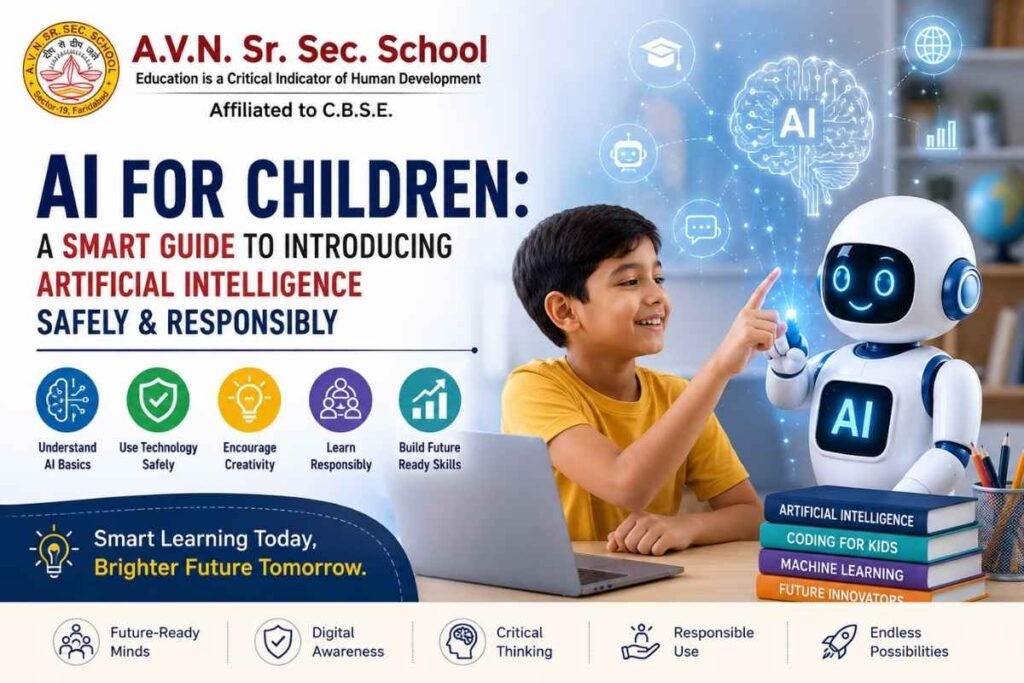
Artificial Intelligence (AI) is no longer something that only scientists and technology companies use. Today, children interact with AI in many ways, whether through voice assistants, educational apps, online learning platforms, or personalized recommendations on digital devices. As AI becomes a bigger part of everyday life, parents and educators need to help children understand how it works and how to use it responsibly.
The goal is not to turn every child into a computer programmer. Instead, it is about helping them develop digital awareness, critical thinking skills, and the confidence to use technology wisely. When introduced correctly, AI can become a valuable learning tool that supports creativity, problem-solving, and future career readiness.
Why Children Should Learn About AI
AI is shaping the future of education, healthcare, business, and many other industries. The children of today will grow up in a world where AI-powered tools are a normal part of work and daily life. Understanding the basics of AI helps them become informed users rather than passive consumers of technology.
Learning about AI can help children:
- Develop problem-solving abilities
- Improve digital literacy
- Understand how technology makes decisions
- Build logical thinking skills
- Prepare for future careers
- Use technology more responsibly
Schools that focus on modern learning approaches often introduce students to emerging technologies while maintaining a strong foundation in academics. Choosing the right educational environment plays a major role in helping children adapt to technological advancements.
Parents looking for a nurturing learning environment can explore the Best School for Kids in Faridabad, where students are encouraged to learn through innovation, creativity, and practical experiences.
What Exactly Is Artificial Intelligence?
Artificial Intelligence refers to computer systems that can perform tasks that normally require human intelligence. These tasks include recognizing speech, answering questions, identifying images, making recommendations, and learning from data.
A simple way to explain AI to children is:
“AI is a smart computer system that learns from information and helps people solve problems.”
Examples children already use include:
- Voice assistants like Siri and Alexa
- YouTube recommendations
- Educational learning apps
- Online translation tools
- AI-powered chatbots
By connecting AI concepts to tools children already know, parents can make learning easier and more engaging.
How to Introduce AI to Children Safely
Start with Basic Concepts
Children do not need complex technical explanations. Begin by explaining that AI learns patterns from information and uses those patterns to make decisions.
Use everyday examples such as:
- How a music app recommends songs
- How a video platform suggests videos
- How navigation apps find the fastest route
Simple examples help children understand AI without feeling overwhelmed.
Encourage Questions
Children are naturally curious. Encourage them to ask questions about how technology works.
Questions like:
- Why did this app recommend that video?
- How does a voice assistant know what I am saying?
- Can computers think like humans?
These discussions help develop critical thinking rather than blind trust in technology.
Teach Responsible AI Usage
Children should understand that AI tools are helpful but not always correct. Sometimes AI can provide inaccurate or incomplete information.
Teach them to:
- Verify information from trusted sources
- Ask parents or teachers when unsure
- Avoid sharing personal information
- Think critically about online content
This habit will help them become responsible digital citizens.
The Role of Schools in AI Education
Schools play an important role in helping children understand technology in a structured and balanced way. A modern educational environment combines traditional learning with digital awareness and practical skills.
A quality CBSE School in Faridabad can help students explore technology while maintaining strong academic foundations, ensuring they are prepared for future challenges.
Educational institutions can support AI learning through:
- Technology-based projects
- Coding activities
- Robotics programs
- Digital literacy lessons
- Collaborative problem-solving exercises
When students learn technology in a guided environment, they gain confidence and develop healthy digital habits.
Balancing AI with Creativity
While AI offers many benefits, children should not become overly dependent on technology. Human creativity, imagination, and emotional intelligence remain essential skills.
Parents should encourage activities such as:
- Reading books
- Drawing and painting
- Storytelling
- Outdoor play
- Group discussions
- Creative writing
Interestingly, many educational experts believe that creativity becomes even more important in an AI-driven world. Children who can think independently and generate original ideas will always have an advantage.
Parents can learn more about fostering innovation by reading this guide on encouraging creative thinking in students.
Setting Healthy Digital Boundaries
Introducing AI does not mean increasing screen time without limits. Healthy digital habits are essential for children’s physical and mental well-being.
Some useful practices include:
Create Screen Time Rules
Set age-appropriate limits for educational and recreational technology use.
Use AI Together
Explore AI-powered tools with your child rather than leaving them unsupervised.
Prioritize Offline Activities
Balance technology use with sports, hobbies, family time, and social interactions.
Monitor Online Safety
Regularly review apps, websites, and platforms your child uses.
These simple steps help children enjoy the benefits of technology while avoiding potential risks.
Skills Children Need in the Age of AI
As AI continues to evolve, certain human skills will become even more valuable.
Critical Thinking
Children should learn how to evaluate information instead of accepting everything they see online.
Communication Skills
Strong communication remains essential in every profession and social setting.
Creativity
AI can generate content, but original ideas still come from human imagination.
Emotional Intelligence
Understanding emotions, empathy, and teamwork cannot be replaced by technology.
Adaptability
Future careers will continue to change, making flexibility and lifelong learning important qualities.
A school environment that nurtures these skills alongside academic excellence helps students thrive in a rapidly changing world. Parents can explore the educational philosophy and learning approach offered by AVN School, which focuses on holistic student development.
Common Myths About AI and Children
Myth 1: AI Will Replace Learning
AI should support learning, not replace it. Teachers and parents remain essential guides in a child’s educational journey.
Myth 2: Children Need Advanced Coding Skills
Understanding AI concepts is more important initially than learning complex programming languages.
Myth 3: AI Is Always Correct
AI systems can make mistakes. Children should learn to verify information and think independently.
Myth 4: Technology Alone Creates Success
Technology is only a tool. Success still depends on hard work, creativity, communication, and strong values.
Final Thoughts
Artificial Intelligence is becoming a normal part of childhood and education. Instead of fearing it, parents and educators should focus on helping children understand and use it responsibly. By teaching the basics of AI, encouraging curiosity, setting healthy digital boundaries, and promoting critical thinking, we can prepare children for a future where technology and human intelligence work together.
The key is balance. Children should learn how AI works while continuing to develop creativity, communication skills, empathy, and independent thinking. With the right guidance from parents and schools, AI can become a powerful tool that enhances learning and opens new opportunities for future success.