- Sector-19, Fridabad-121002, Haryana, India
- +91 129 403 7300
- +91 971 759 0012
- Info@avnschoolfaridabad.com

How Early Exposure to Technology Shapes Students’ Learning and Problem-Solving Skills

When Students Become Problem-Solvers, Not Just Test-Takers
October 5, 2026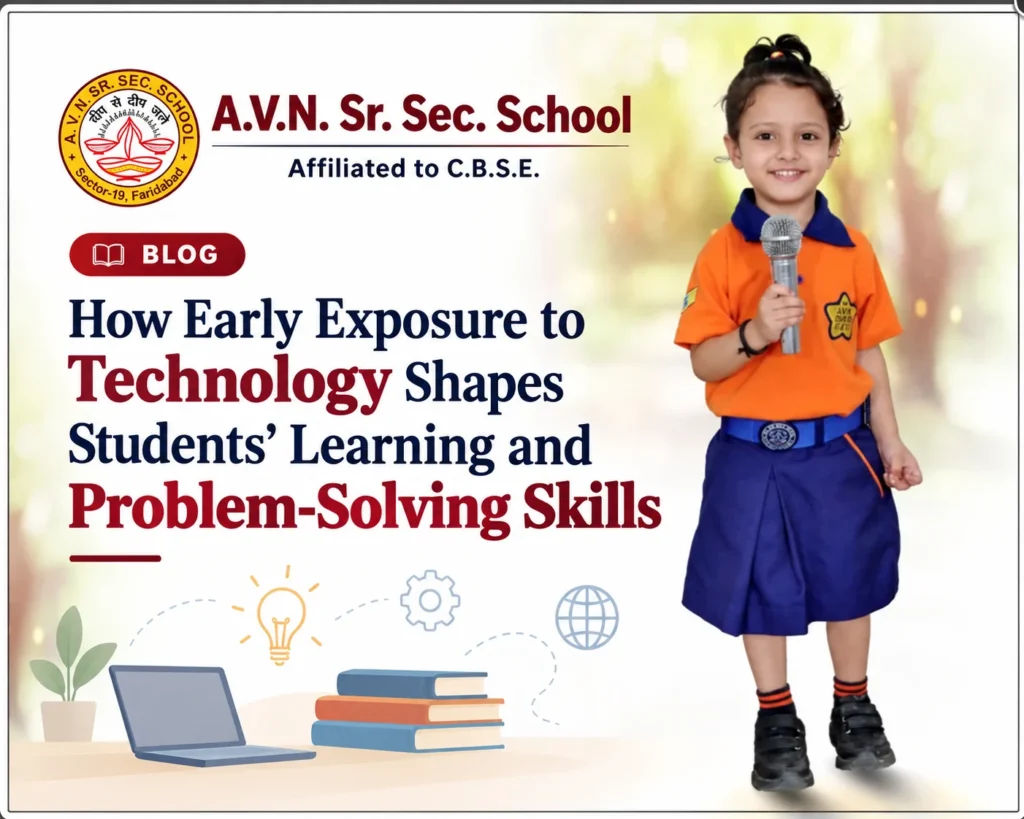
Technology has become an important part of everyday life, influencing how people communicate, learn, and solve problems. For school students, early exposure to digital tools can create opportunities to explore new ideas, understand difficult concepts, and develop practical skills. However, the educational value of technology depends on how appropriately and purposefully it is introduced.
Modern education is no longer limited to textbooks and classroom lectures. Interactive lessons, educational applications, digital simulations, and online research resources can help students participate more actively in learning.
When technology is introduced at the right age with proper guidance, it can support critical thinking, creativity, and independent problem-solving. Understanding this relationship helps parents and educators make informed decisions about children’s education.
Understanding the Role of Technology in Early Education
Early exposure to technology does not simply mean allowing children to use smartphones, tablets, or computers. It involves introducing age-appropriate digital resources that support specific learning objectives.
For younger students, this might include interactive storytelling, educational puzzles, and visual learning activities. Older students may benefit from coding exercises, digital presentations, research assignments, and educational simulations.
The goal is to encourage meaningful interaction rather than passive screen consumption.
For example, an interactive mathematics application can allow children to experiment with different solutions and receive immediate feedback. This experience helps them understand mathematical concepts through exploration instead of memorising procedures alone.
However, technology should complement classroom instruction, physical activities, and personal interaction rather than replace them.
How Technology Develops Problem-Solving Skills
Problem-solving is an essential skill that students use throughout their academic and personal lives. Digital learning activities can provide structured opportunities to practise this ability.
When students participate in coding exercises, logic games, or virtual science experiments, they encounter challenges requiring observation, analysis, and decision-making.
Consider a simple coding activity where students must programme a character to navigate a maze.
To complete the challenge, they must:
- Identify the problem and understand the objective.
- Break the task into smaller steps.
- Test different possible solutions.
- Recognise errors and make corrections.
- Evaluate whether their final solution works.
This process encourages logical reasoning, persistence, and systematic thinking.
These abilities extend beyond technology-related subjects and can support students when approaching mathematics, science, and everyday challenges.
Encouraging Critical Thinking Through Digital Learning
Access to information does not automatically improve understanding. Students must learn how to evaluate what they read, watch, and hear.
Digital literacy becomes especially important as children begin using search engines, educational websites, and AI-powered tools.
Teachers can encourage critical thinking by asking students to compare information from different sources, identify supporting evidence, and explain their conclusions.
For example, during a classroom project about environmental conservation, students might research pollution using different educational resources.
Instead of copying information directly, they can examine whether the sources are reliable and whether the claims are supported by evidence.
This approach develops analytical thinking while helping students recognise misinformation and misleading online content.
Making Complex Subjects Easier to Understand
Some academic concepts are difficult to explain through written descriptions alone. Digital visualisations can make abstract subjects more accessible.
In science lessons, animations can demonstrate the movement of planets, the functioning of human organs, or the process of photosynthesis.
Similarly, interactive geometry applications allow students to explore shapes, angles, and measurements.
These resources provide opportunities to observe concepts from different perspectives.
Students who struggle with traditional explanations may benefit from additional examples, visual demonstrations, or repeated practice.
Nevertheless, teachers remain essential for identifying misunderstandings, answering questions, and ensuring that students develop a complete understanding of the subject.
Technology is most effective when selected according to learning needs rather than introduced simply because it is available.
Building Creativity and Independent Learning
Digital tools can provide students with opportunities to express ideas in different formats.
Creating presentations, designing simple animations, producing digital artwork, or developing multimedia projects encourages students to organise information creatively.
For example, students studying local history might create a digital timeline combining photographs, written explanations, and historical events.
Such assignments require research, planning, communication, and creativity.
Independent learning also improves when students understand how to use educational resources responsibly.
They can revisit difficult lessons, explore additional explanations, and practise skills outside regular classroom hours.
However, independence should develop gradually. Younger learners still require guidance in selecting suitable content and managing their learning activities.
Why Balanced Technology Exposure Matters
Although digital resources offer educational opportunities, excessive or poorly supervised screen use may interfere with other important activities.
Children also need physical exercise, outdoor play, reading, face-to-face communication, and adequate sleep.
For this reason, schools should focus on the quality of technology use rather than the total number of digital devices available.
A balanced learning environment combines digital activities with discussions, practical experiments, group projects, and traditional teaching methods.
Parents searching for the Best School in Faridabad should consider how effectively a school balances modern learning resources with students’ academic, social, and emotional development.
Technology integration should have a clear educational purpose and should never come at the expense of essential childhood experiences.
The Role of Teachers in Developing Digital Skills
Teachers play an important role in helping students use technology productively.
Their responsibility extends beyond demonstrating how digital devices work. They must also teach students when, why, and how technology should be used.
Effective classroom practices may include guided online research, collaborative projects, digital safety discussions, and activities that require students to explain their reasoning.
Teachers can also encourage students to question AI-generated answers rather than accepting them without verification.
For families considering a CBSE School in Faridabad, understanding how digital learning is integrated with classroom teaching can be an important consideration.
The emphasis should remain on meaningful learning outcomes rather than technological appearances.
How Parents Can Support Healthy Technology Habits
Learning does not end when students leave the classroom. Parents can reinforce responsible digital habits through everyday activities.
Establishing age-appropriate boundaries, discussing online safety, and encouraging educational content selection can help children develop healthier relationships with technology.
Parents can also participate in digital learning activities by asking children to explain what they have discovered.
Rather than focusing exclusively on screen time, families should consider whether digital activities encourage creativity, understanding, and meaningful engagement.
Maintaining device-free periods for meals, physical recreation, and bedtime can further support a balanced routine.
Preparing Students for a Technology-Driven Future
As technology continues to influence education and employment, students will increasingly need the ability to adapt, evaluate information, and solve unfamiliar problems.
Early digital exposure can contribute to these abilities when combined with strong foundational knowledge, communication skills, and responsible decision-making.
Schools that encourage curiosity, experimentation, and thoughtful technology use can help students become more confident learners.
The objective is not simply to prepare children to operate digital devices but to help them understand how technology can support learning and problem-solving.
Conclusion
Early exposure to technology can positively influence students’ learning experiences when introduced with clear educational goals and appropriate supervision.
Digital activities can strengthen problem-solving, critical thinking, creativity, and independent learning. However, these benefits depend on thoughtful teaching practices and balanced usage.
By combining technology with traditional education, practical activities, and human interaction, schools and parents can help children develop the knowledge and skills needed to navigate an increasingly digital world.