- Sector-19, Fridabad-121002, Haryana, India
- +91 129 403 7300
- +91 971 759 0012
- Info@avnschoolfaridabad.com

Wise Discipline: How Positive Guidance Helps Children Become Responsible Individuals

What Is the 3C Curriculum? A Complete Guide for Parents
September 4, 2026
Nurturing Values Beyond Education: Janmashtami Celebration AssemblyClass – Nursery
September 11, 2026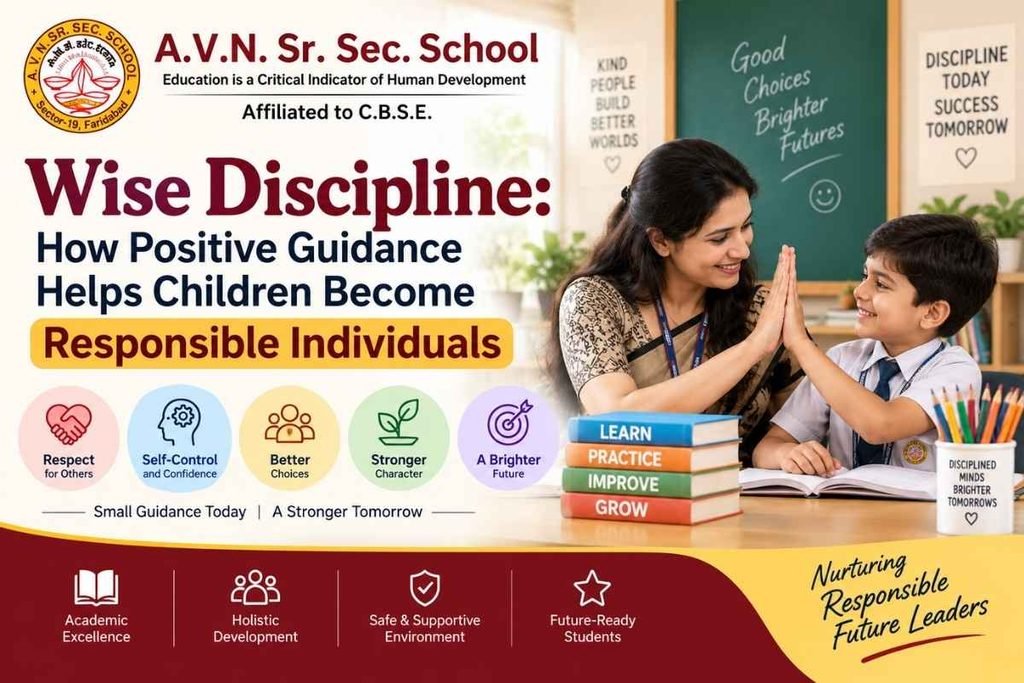
Introduction
Discipline is an important part of a child’s education, but discipline should not simply mean rules, punishments, or restrictions. Effective discipline is about helping children understand boundaries, make responsible choices, manage their behaviour, and learn from their mistakes.
This is where wise discipline becomes important. Instead of controlling children through fear, positive guidance teaches them why certain behaviours are appropriate and helps them develop self-discipline over time. A supportive school environment can play a major role in this process by combining clear expectations with patience, understanding, and consistent guidance.
For parents choosing a school, it is therefore worth looking beyond academic performance. The right educational environment should also help children develop responsibility, respect, confidence, and good character.
What Is Wise Discipline?
Wise discipline is an approach that focuses on guidance rather than punishment. Its purpose is to help children understand the consequences of their actions and gradually learn to make better decisions independently.
A child who is disciplined wisely is not simply told what they cannot do. Instead, they are encouraged to understand:
- Why a particular rule exists
- How their actions affect others
- What consequences may follow their choices
- How they can correct their mistakes
- How to make better decisions in the future
This approach helps children develop an internal sense of responsibility rather than behaving appropriately only because an adult is watching.
Why Discipline Matters in a Child’s Development
Children are still developing their emotional, social, and decision-making abilities. They naturally make mistakes while learning how to interact with others and handle different situations.
Appropriate discipline provides the structure children need to develop these abilities.
It can help children learn:
- Respect for others
- Self-control
- Patience
- Responsibility
- Accountability
- Time management
- Cooperation
- Decision-making
These qualities become increasingly important as children grow older. A student who learns to manage responsibilities at school is more likely to carry those habits into higher education, relationships, and eventually professional life.
Discipline Should Teach, Not Frighten
Fear-based discipline may produce immediate obedience, but it does not necessarily teach children how to make good decisions independently.
For example, if a student breaks a classroom rule and is simply punished, they may learn to avoid getting caught. But if the teacher discusses why the behaviour was inappropriate and encourages the student to understand its consequences, the child has an opportunity to learn from the experience.
This distinction is important.
Punishment focuses on what happened. Wise discipline focuses on what the child can learn from what happened.
That does not mean schools should avoid consequences. Rather, consequences should be reasonable, consistent, and connected to the behaviour whenever possible.
Setting Clear and Consistent Expectations
Children need clear boundaries. Without them, they may struggle to understand what is expected of them.
A well-managed school environment establishes simple and understandable expectations related to:
- Classroom behaviour
- Attendance and punctuality
- Respectful communication
- Completing responsibilities
- Taking care of school property
- Following safety guidelines
- Working cooperatively with classmates
Consistency is equally important. Rules that change depending on the situation or person can confuse children.
When expectations are communicated clearly and applied fairly, students gradually understand that their choices have consequences.
Encouraging Children to Take Responsibility
One of the main goals of wise discipline is to move children from being controlled by adults to managing themselves.
Teachers can encourage this by giving students age-appropriate responsibilities. A child might be responsible for organising classroom materials, completing a group task, helping younger students, or managing a particular school activity.
These small responsibilities teach an important lesson: being part of a community means contributing to it.
Over time, students begin to understand that responsibility is not something imposed on them. It is something they demonstrate through their actions.
The Role of Teachers in Positive Discipline
Teachers have a significant influence on how children understand discipline.
A teacher who remains calm, listens to students, explains expectations, and responds consistently can create a classroom where discipline becomes part of learning.
Instead of immediately labelling a child as “naughty” or “careless,” teachers can try to understand the reason behind a particular behaviour.
For example, a student who repeatedly fails to complete assignments may need help with organisation or time management rather than simply receiving criticism.
This does not mean ignoring poor behaviour. It means addressing the underlying issue while still maintaining appropriate standards.
Building Emotional Intelligence
Wise discipline is closely connected with emotional development.
Children need to learn how to recognise emotions such as anger, frustration, disappointment, jealousy, and anxiety. They also need strategies for responding to these emotions appropriately.
Schools can support this through:
- Classroom discussions
- Counselling support
- Group activities
- Role-playing exercises
- Mindfulness activities
- Sports and creative programs
When children understand their emotions, they are better equipped to control impulsive reactions and resolve disagreements constructively.
Teaching Children to Learn From Mistakes
Mistakes are a natural part of growing up. A healthy approach to discipline does not treat every mistake as a failure.
Instead, students should be encouraged to ask:
What happened? Why did it happen? What could I have done differently? What can I do next time?
This encourages reflection and develops problem-solving skills.
A child who learns to reflect on mistakes can gradually become more independent and resilient. They understand that making a mistake does not define them, but refusing to learn from it can prevent growth.
Discipline and Academic Success
Discipline also contributes to academic development.
Students need regular habits to succeed academically. They must attend classes, complete assignments, manage their time, listen carefully, and stay focused on their goals.
A disciplined learning environment helps children develop these habits without making education unnecessarily stressful.
Parents looking for a leading CBSE learning environment in Faridabad should consider how a school balances academic expectations with positive student guidance.
The objective should not simply be to produce students who follow instructions. It should be to develop learners who can eventually manage their own responsibilities.
The Importance of Co-Curricular Activities
Discipline is not developed only inside the classroom. Sports, arts, music, competitions, clubs, and other activities provide valuable opportunities for children to practise responsibility and teamwork.
Sports, for example, teach students to follow rules, respect opponents, cooperate with teammates, and handle both success and disappointment.
Similarly, participating in a school performance or project requires preparation, punctuality, collaboration, and commitment.
Parents exploring a strong school environment for children in Faridabad should therefore look for opportunities that allow students to develop discipline through meaningful experiences.
Parents and Schools Must Work Together
Children receive the strongest guidance when expectations at home and school are reasonably consistent.
Parents can support positive discipline by:
- Setting clear household expectations
- Giving children age-appropriate responsibilities
- Praising responsible behaviour
- Avoiding unnecessary threats
- Listening before reacting
- Allowing reasonable consequences
- Encouraging children to solve age-appropriate problems independently
Regular communication between parents and teachers can also help identify behavioural patterns and ensure that children receive consistent guidance.
Preparing Children for Life Beyond School
The ultimate purpose of discipline is not to make children obedient for the sake of obedience. It is to help them become adults who can make responsible choices without constant supervision.
A modern CBSE educational institution serving families across Faridabad NCR and Haryana can contribute to this development by combining academic learning with values, life skills, leadership opportunities, and responsible behaviour.
Similarly, parents considering a CBSE school in Faridabad, Haryana should examine whether the school’s approach encourages students to become independent thinkers and responsible members of society.
What Parents Should Look for in a School
When evaluating schools, parents should ask more than “How strict is the school?”
Better questions include:
- Are school rules clearly explained?
- Are students treated with respect?
- Are consequences fair and consistent?
- Are children encouraged to take responsibility?
- Do teachers listen to students?
- Does the school support emotional development?
- Are leadership and teamwork opportunities available?
- Does the school help students learn from mistakes?
The answers can reveal much about the school’s educational philosophy.
Conclusion
Wise discipline is about teaching children how to manage themselves, not simply telling them what to do. Through clear boundaries, positive guidance, consistent expectations, meaningful responsibilities, and opportunities to learn from mistakes, children can gradually develop self-control and accountability.
Schools and parents both have an important role to play in this process. When children are guided with firmness, fairness, and empathy, discipline becomes an opportunity for character development rather than a source of fear.
Ultimately, the goal is to help children grow into individuals who can think before they act, accept responsibility for their choices, respect others, and handle challenges with confidence. That is the kind of discipline that continues to benefit them long after they leave the classroom.