- Sector-19, Fridabad-121002, Haryana, India
- +91 129 403 7300
- +91 971 759 0012
- Info@avnschoolfaridabad.com
What Is the 3C Curriculum? A Complete Guide for Parents

From Classrooms to Careers: How Top Schools Foster Logic
August 21, 2026
Wise Discipline: How Positive Guidance Helps Children Become Responsible Individuals
September 7, 2026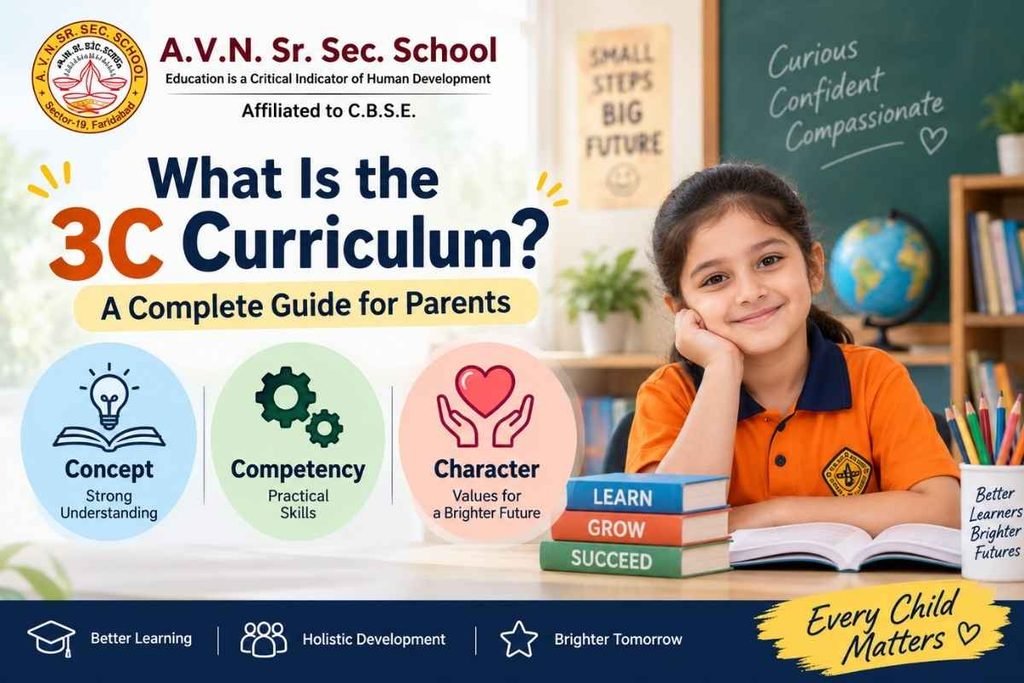
Introduction
Choosing the right school for your child is about more than academic results, infrastructure, or examination scores. Parents today are looking for an educational approach that helps children become confident, curious, creative, and capable of handling real-world challenges.
This is where the 3C Curriculum comes into focus. Designed around three important areas of development, the 3C approach aims to create a more engaging and balanced learning experience for children. But what exactly does 3C mean, and how can it benefit your child?
In this guide, we explore the concept of the 3C Curriculum, its key principles, benefits, and what parents should look for when evaluating a school that follows a modern, child-focused approach.
What Is the 3C Curriculum?
The 3C Curriculum is generally built around three core areas: Concept, Competency, and Character. Together, these areas encourage schools to move beyond traditional textbook-based teaching and focus on the complete development of a child.
The three components work together:
- Concept focuses on understanding knowledge and ideas.
- Competency focuses on applying knowledge through practical skills.
- Character focuses on values, attitudes, confidence, and responsible behaviour.
The idea is simple: children should not only know what something is but also understand how it works, know how to use that knowledge, and develop the qualities required to use it responsibly.
1. Concept: Building Strong Understanding
The first C stands for Concept. A strong conceptual foundation is essential for effective learning.
Instead of encouraging children to memorise information simply for examinations, concept-based education focuses on helping them understand the subject.
For example, instead of simply memorising mathematical formulas, students can be encouraged to understand why those formulas work and where they can be applied. Similarly, science becomes more meaningful when children can connect classroom concepts with everyday experiences.
Concept-based learning can involve:
- Interactive classroom discussions
- Experiments and demonstrations
- Real-life examples
- Question-and-answer sessions
- Projects and activities
- Visual and digital learning resources
When children understand concepts properly, they are more likely to remember them and apply them in unfamiliar situations.
2. Competency: Turning Knowledge into Skills
The second C represents Competency. Knowing something is useful, but being able to apply that knowledge is even more valuable.
Competency-based learning encourages children to develop practical skills such as problem-solving, communication, collaboration, critical thinking, creativity, and decision-making.
For instance, a student may learn about environmental pollution in a textbook. A competency-focused approach could involve asking the student to identify an environmental issue around them, research its causes, discuss possible solutions, and present their findings.
This changes the learning process from simply receiving information to actively using it.
It also prepares children for situations they may encounter outside school, where there may not always be a textbook answer to a problem.
3. Character: Developing Responsible Individuals
The third C focuses on Character.
Education should help children become responsible and respectful individuals, not just academically successful students. Character development includes values and behaviours such as honesty, empathy, discipline, resilience, responsibility, respect, and teamwork.
Schools can develop these qualities through everyday classroom interactions, group activities, sports, leadership opportunities, community initiatives, and discussions about values.
Character development is particularly important because academic knowledge alone cannot determine how a person handles challenges, relationships, responsibilities, or failures.
A child who learns how to persevere after making a mistake may be better prepared for future challenges than a child who has only learned how to achieve high marks.
Why Is the 3C Approach Important?
The traditional education model often places considerable emphasis on academic performance. While academics remain essential, children also need skills and values that help them function effectively in the real world.
The 3C approach attempts to create a balance between these different aspects of development.
It can help students:
- Understand subjects more deeply
- Apply knowledge in practical situations
- Think independently
- Communicate their ideas confidently
- Work effectively with others
- Handle challenges and setbacks
- Develop creativity and curiosity
- Become more responsible and socially aware
This makes learning more meaningful rather than simply examination-oriented.
How Does 3C Learning Change the Classroom?
A classroom following a 3C-inspired approach may look quite different from a traditional lecture-based classroom.
Instead of the teacher doing most of the talking, students may participate more actively. They might work in groups, conduct experiments, solve problems, create presentations, participate in discussions, or complete projects.
Teachers become facilitators who guide students towards understanding rather than simply providing every answer.
This approach can also encourage children to ask questions without being afraid of making mistakes. That matters because genuine learning often happens when students investigate something they do not yet understand.
The Role of Technology in 3C Education
Technology can further support the three areas of learning when used appropriately.
Digital simulations can help students understand complex concepts. Interactive platforms can provide opportunities to practise skills, while multimedia resources can make difficult topics easier to visualise.
However, technology should support teaching rather than replace meaningful interaction between teachers and students.
A well-designed educational environment combines technology with discussions, practical activities, books, experiments, sports, creative work, and personal guidance.
3C Curriculum and Holistic Development
One of the strongest aspects of the 3C approach is its focus on the whole child.
A child’s development should not be measured only through examination results. Confidence, communication, creativity, emotional maturity, physical development, and social skills are also important.
Parents considering a <a href=”https://avnschoolfaridabad.com/best-cbse-school-in-faridabad/”>leading CBSE education option in Faridabad</a> should therefore look beyond academic results and understand how the school approaches overall student development.
A strong curriculum should give children opportunities to explore their interests through sports, arts, music, public speaking, technology, clubs, and other co-curricular activities.
What Should Parents Look for in a 3C-Focused School?
Parents should not assume that a school follows a child-focused curriculum simply because it uses modern terminology. It is important to look at how the approach is actually implemented.
Consider asking:
Does the school encourage conceptual understanding?
Look for classrooms where children are encouraged to ask questions and understand the reasoning behind what they learn.
Are practical skills developed?
Check whether students participate in projects, experiments, presentations, teamwork, and problem-solving activities.
Is character development part of everyday education?
Look for opportunities that promote responsibility, empathy, leadership, discipline, and respect.
Are children given individual attention?
Every child learns differently, so personalised guidance can make a significant difference.
Parents searching for a <a href=”https://avnschoolfaridabad.com/best-school-for-kids-in-faridabad/”>quality school environment for children in Faridabad</a> should evaluate these factors rather than relying solely on rankings or promotional claims.
3C Curriculum and the Future of Education
The skills required in the future workplace are changing rapidly. Students will need to adapt to new technologies, work with diverse teams, solve unfamiliar problems, and continue learning throughout their lives.
This makes the combination of knowledge, skills, and character increasingly important.
A modern <a href=”https://avnschoolfaridabad.com/cbse-school-in-faridabad-ncr-haryana/”>CBSE school serving families across Faridabad NCR and Haryana</a> can support this shift by creating opportunities for students to learn through practical experiences rather than relying exclusively on conventional classroom instruction.
Similarly, parents considering a <a href=”https://avnschoolfaridabad.com/cbse-school-in-faridabad-haryana/”>CBSE school in Faridabad, Haryana</a> should consider whether its curriculum prepares children for both academic challenges and life beyond school.
Benefits for Parents and Students
The 3C approach can also provide parents with a broader understanding of their child’s progress.
Instead of asking only, “What marks did my child get?”, parents can consider questions such as:
- Does my child understand what they are learning?
- Can they apply their knowledge?
- Are they becoming more confident?
- Can they work with others?
- How do they respond to challenges?
- Are they developing independence and responsibility?
These questions provide a more complete picture of educational growth.
Conclusion
The 3C Curriculum, centred on Concept, Competency, and Character, represents an approach to education that looks beyond marks and memorisation. It aims to help children understand what they learn, apply their knowledge effectively, and develop the personal qualities needed to navigate life confidently.
For parents, the key is not simply finding a school that mentions the 3C approach. What matters is how effectively the school puts these principles into practice.
A meaningful education should give children strong academic foundations while also encouraging curiosity, creativity, communication, responsibility, and independent thinking. When these elements come together, students are better equipped not only to perform well in school but also to become capable and confident individuals for the future.