- Sector-19, Fridabad-121002, Haryana, India
- +91 129 403 7300
- +91 971 759 0012
- Info@avnschoolfaridabad.com
When Students Become Problem-Solvers, Not Just Test-Takers

Workshop on Life Skills under CBP
October 5, 2026
How Early Exposure to Technology Shapes Students’ Learning and Problem-Solving Skills
October 12, 2026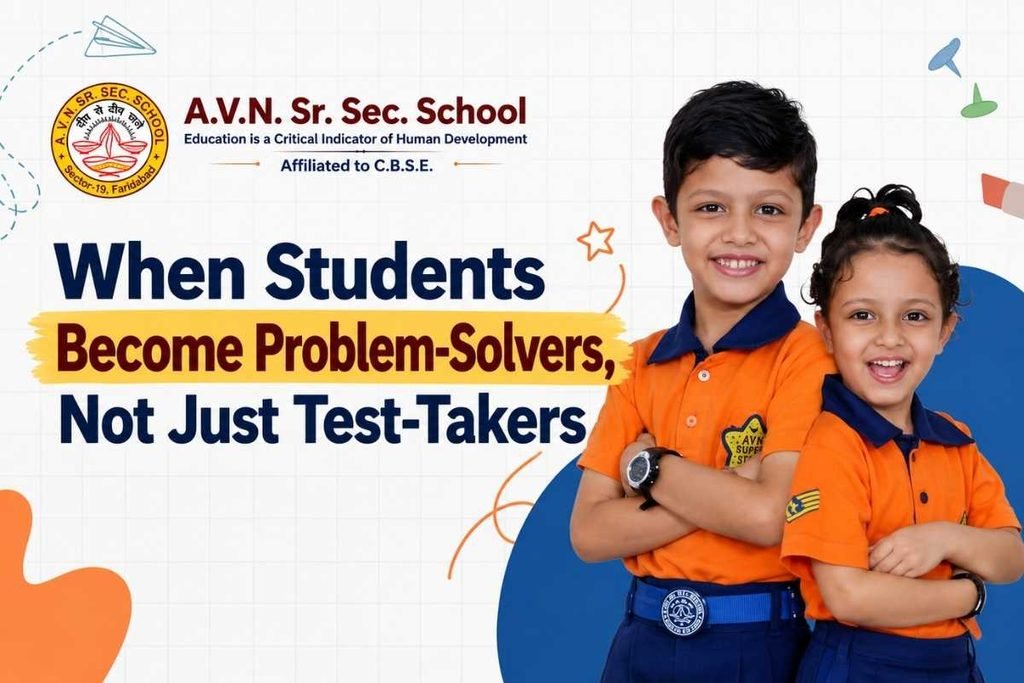
For many years, school success has often been measured through marks, test scores and examination results. Good grades are certainly important, but they are only one part of a student’s development. In the real world, students will face situations where there is no textbook answer, no multiple-choice option and no teacher standing beside them to explain what to do.
They will need to ask questions, understand problems, consider different possibilities and find solutions.
This is why modern education needs to focus not only on what students know, but also on how they use what they know. When students become problem-solvers instead of simply test-takers, they become more confident, independent and prepared for challenges beyond school.
For parents exploring Schools in Faridabad, this shift is worth considering. A strong school environment should help students build academic knowledge while also giving them opportunities to apply that knowledge in practical situations.
Why Being a Good Test-Taker Is Not Enough
Examinations teach students many useful habits. They learn discipline, time management, revision and how to organise information. However, real-life problems are rarely presented like examination questions.
A student may know the formula for calculating an area but still struggle to decide how to use it when planning the layout of a real space.
A student may remember scientific facts but find it difficult to explain how those facts can help solve an environmental problem.
A student may score well in language tests but still need practice in expressing an original idea during a presentation.
These examples show why education needs to move beyond memorisation. Students need opportunities to apply, question, analyse and create.
What Does a Student Problem-Solver Look Like?
A problem-solving student does not necessarily have an immediate answer to every question.
Instead, they know how to approach a difficult situation.
They may ask:
- What exactly is the problem?
- What information do I already have?
- What information am I missing?
- What could be causing this problem?
- What solutions are possible?
- Which solution is most practical?
- What could happen if my solution does not work?
These questions encourage students to slow down and think instead of immediately looking for an answer.
This ability becomes valuable across almost every subject and, later, almost every career.
Classroom Questions Can Build Better Thinkers
One simple way teachers can encourage problem-solving is by changing the type of questions students receive.
Instead of always asking, “What is the correct answer?” teachers can also ask, “Why do you think this happened?” or “Can you find another way to solve it?”
For example, instead of asking students to simply learn about pollution, a teacher could ask them to identify a pollution-related problem around their school and suggest practical solutions.
Students might research the issue, discuss possible causes, collect information and present their recommendations.
The activity teaches science, research, communication and teamwork at the same time.
Most importantly, students learn that knowledge can be used to solve real problems.
Learning Through Real-Life Situations
Problem-solving becomes stronger when students can connect classroom learning with everyday life.
Mathematics can be connected with budgeting, shopping, measurements and planning.
Science can be connected with energy use, water conservation, health and the environment.
Social science can be connected with communities, local issues and responsible citizenship.
Language learning can involve writing proposals, creating presentations, interviewing people or discussing real-world topics.
This approach helps students understand why they are learning something rather than seeing every subject as a collection of chapters that must be completed before an examination.
Projects Can Turn Students Into Problem-Solvers
Project-based learning gives students an opportunity to take greater responsibility for their learning.
A project does not always have one perfect method. Students may need to decide how to research a topic, divide responsibilities, organise information and present their final work.
For example, students could be asked to design an idea for making their school more environmentally friendly.
One group might study electricity usage. Another could look at water conservation. Others could explore waste management or the use of plants around the school.
Students then need to compare their findings and decide which ideas are practical.
This process develops skills that cannot always be measured through a written examination.
Mistakes Are Part of Problem-Solving
One important part of becoming a problem-solver is learning how to handle failure.
When students are always expected to give the correct answer on the first attempt, they may become afraid of making mistakes. This can prevent them from experimenting or trying unfamiliar approaches.
A healthy learning environment allows students to make mistakes, understand what went wrong and try again.
For example, if a student’s science experiment does not produce the expected result, the experience can become a learning opportunity. The student can investigate the possible reason, change the method and repeat the experiment.
The lesson is not simply that the first attempt failed. The student learns how to respond when something does not work.
That is a skill that remains valuable throughout life.
Technology and AI Make Problem-Solving Even More Important
Technology has made information easier to access than ever before. Students can find explanations, examples and answers within seconds.
Artificial intelligence has made this even faster.
But easy access to answers creates a new challenge. If students always ask technology to solve a problem for them, they may miss the opportunity to develop their own reasoning skills.
The better approach is to use technology as a support for thinking.
Students can use AI to brainstorm ideas, explain difficult concepts, generate practice questions or provide alternative viewpoints. They should then evaluate the information, verify important facts and develop their own conclusions.
This makes critical thinking an important part of modern problem-solving.
The goal is not to prevent students from using technology. It is to help them become smart and responsible users of it.
Teachers Have an Important Role
Teachers remain central to developing problem-solving skills.
A teacher can recognise when a student needs additional guidance, ask the right follow-up question and encourage the student to think instead of immediately providing an answer.
Sometimes the most useful response from a teacher is not the solution itself, but another question.
For example:
“Why did you choose this method?”
“What would happen if you changed this step?”
“Is there another way to approach the problem?”
Questions like these encourage students to explain their thinking.
This helps teachers understand not only what answer a student has reached, but also how the student reached it.
Problem-Solving Builds Confidence
When students solve problems independently, they begin to trust their own abilities.
A student who successfully works through a difficult mathematics problem may become more willing to attempt another challenging question.
A student who leads a successful group project may become more comfortable taking responsibility.
A student who presents a solution to a real-world problem may become more confident in communicating ideas.
These experiences gradually build a mindset that says, “I may not know the answer yet, but I can work towards finding it.”
That mindset can be more valuable than simply knowing the answer immediately.
Schools Should Give Students Opportunities to Think
For parents choosing a school, it can be useful to look beyond academic results and ask how students are encouraged to think.
Do students participate in projects?
Are they encouraged to ask questions?
Do they get opportunities to conduct experiments?
Are classroom discussions part of learning?
Can students work together on practical problems?
Are they encouraged to explain their reasoning?
These experiences can make a significant difference in how students approach challenges.
A CBSE Affilated School in Faridabad can combine the structured academic framework of the CBSE curriculum with activities that encourage students to apply knowledge and develop broader skills.
Similarly, an English Medium School of Faridabad can use communication activities, discussions, presentations and projects to help students express their ideas while developing confidence.
Preparing Students for Life Beyond School
The problems students face as adults will not come with marks allocated to each step.
At university, students will need to manage assignments, research information and make decisions independently. At work, they may need to solve unexpected problems, collaborate with colleagues and adapt to changing situations.
Even in everyday life, people constantly make decisions based on incomplete information.
This is why schools have an opportunity to develop more than academic performance.
For Schools in Faridabad, creating opportunities for students to become independent thinkers can be an important part of preparing them for the future. Academic knowledge gives students the foundation, while problem-solving teaches them how to use that knowledge.
Conclusion
Students should certainly learn facts, concepts and academic skills. Examinations will continue to be an important part of education. But education becomes more meaningful when students also learn how to use their knowledge beyond the examination hall.
A problem-solving student does not simply ask, “What is the answer?”
They learn to ask, “Why is this happening, what can I do about it, and how can I find a better solution?”
When schools encourage curiosity, experimentation, teamwork, critical thinking and independent decision-making, students gradually become more than successful test-takers. They become confident learners who are better prepared to face unfamiliar situations.
The ultimate goal of education is not to prepare students for one examination. It is to give them the ability to keep learning, thinking and solving problems throughout their lives.