- Sector-19, Fridabad-121002, Haryana, India
- +91 129 403 7300
- +91 971 759 0012
- Info@avnschoolfaridabad.com

Is Scrolling Killing Your Grades? How to Use Social Media Smartly

🌟 Celebrating Creativity and Achievement!
July 31, 2026
Beyond the Classroom: How Experiential Schools Bring Learning to Life
August 10, 2026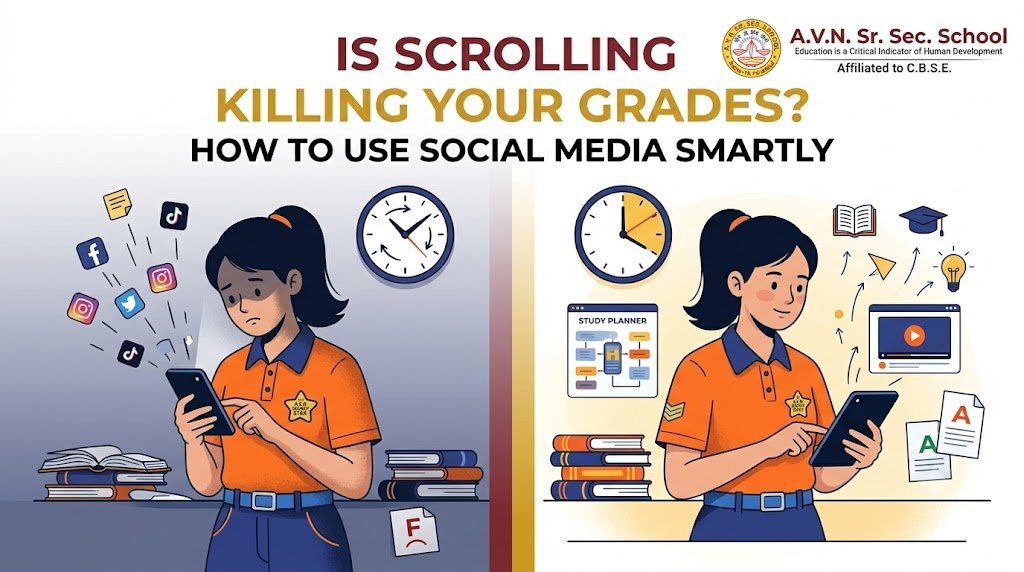
We’ve all been there: you sit down to study, promising yourself you’ll just check one notification. Before you know it, an hour has vanished into a black hole of reels, stories, and memes. For today’s students, social media is a constant companion—but is it acting as a helpful study buddy or a silent grade killer?
The truth is, social media itself isn’t the enemy. It is a powerful tool. Like any tool, its impact depends entirely on how you use it.
Here is a breakdown of how the digital world affects academic performance and, more importantly, how you can flip the script to make social media work for you.
The Dark Side: How Mindless Scrolling Hurts Academic Performance
It is no secret that a phone buzzing on the desk is the ultimate distraction. But the effects of social media go deeper than just a momentary lapse in focus:
- Fragmented Attention: Social media platforms are designed to feed you quick hits of dopamine. Constantly switching between a textbook and a feed prevents the deep, focused concentration required to grasp complex subjects.
- The Sleep Thief: The blue light emitted by screens suppresses melatonin, and engaging content keeps the brain wired. Studies associate heavy evening social media use with poorer sleep quality, which directly impairs memory retention and next-day cognitive function.
- Procrastination Station: It is incredibly easy to delay assignments when endless entertainment is just a tap away. This often leads to last-minute cramming, heightened stress, and ultimately, lower grades.
For parents seeking an environment that actively combats these distractions, finding the Best CBSE School in Faridabad can make a massive difference. Schools with structured, engaging learning environments help reinforce focus and discipline offline.
The Bright Side: Using the Feed to Your Advantage
Despite the drawbacks, going completely off the grid isn’t necessary—or even beneficial. When used intentionally, social media becomes a massive asset to education:
- Collaborative Learning: Platforms like WhatsApp, Discord, or Facebook Groups are fantastic for sharing notes, forming study groups, and crowdsourcing answers to difficult questions.
- Endless Educational Resources: YouTube, Pinterest, and even niche short-form video creators offer incredible visual tutorials on everything from balancing chemical equations to mastering historical timelines.
- Networking and Inspiration: Following industry leaders, academic pages, or university accounts can keep you motivated and informed about future career paths.
When searching for the Best School for Kids in Faridabd, modern parents increasingly value institutions that teach digital literacy—showing students how to harness the internet for research and collaboration rather than just passive consumption.
Smart Strategies: Reclaiming Your Time and Focus
You don’t need to delete your apps to get your grades back on track. You just need a game plan. Here are actionable strategies to consume content smartly:
- Create Tech-Free Study Zones: Your brain relies on environmental cues. Keep your phone in another room while doing homework. If you need your phone for research, use website blockers to temporarily lock distracting apps.
- Curate Your Feed: Audit who you follow. Unfollow accounts that make you feel inadequate or waste your time, and replace them with educational creators, study-gram accounts, and motivational pages.
- Audit Your Screen Time: Most smartphones track how you spend your time. Review your weekly averages and set hard daily limits on your most heavily used entertainment apps.
- Embrace the “Do Not Disturb” Mode: When it’s time to study, shut down the noise. The world will not end if you wait two hours to reply to a non-urgent message.
At the end of the day, success comes down to balance and holistic development—qualities nurtured by the Best School in Faridabad. By setting boundaries and shifting from a passive consumer to an active learner, you can keep your digital life thriving without sacrificing your GPA.