- Sector-19, Fridabad-121002, Haryana, India
- +91 129 403 7300
- +91 971 759 0012
- Info@avnschoolfaridabad.com
Why Mother Tongue Education Matters Alongside English

World Environment Day – Primary Wing
June 12, 2026
Workshop for Pre Primary Educators on NextGen Learning by Ms Geetanjali Uniyal
June 27, 2026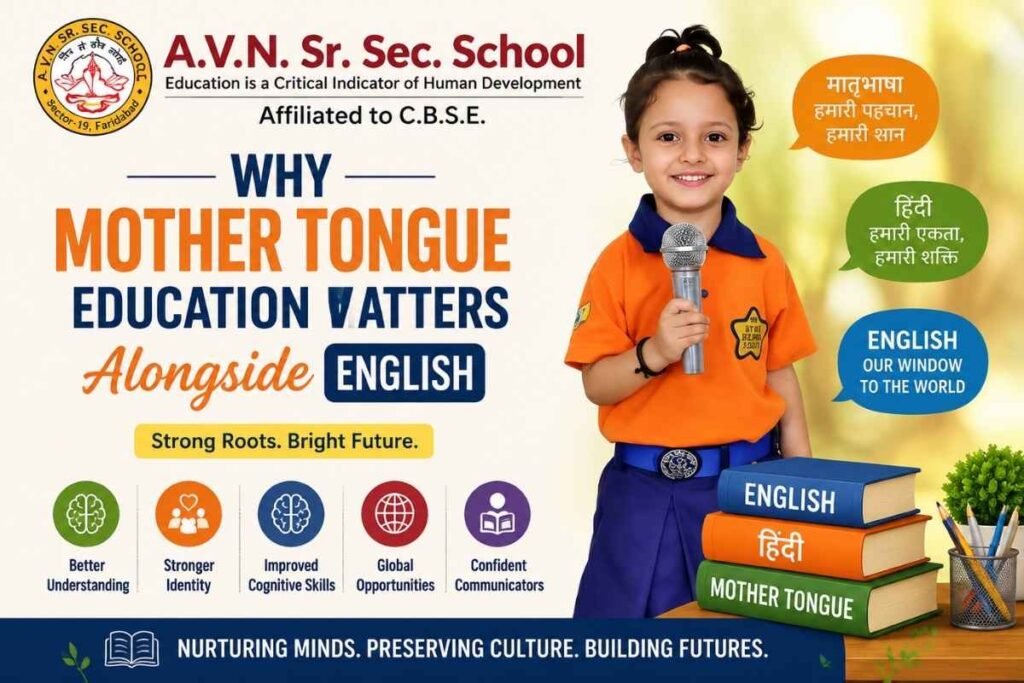
Language is much more than a tool for communication. It shapes the way children think, learn, express emotions, and understand the world around them. In today’s globalized world, English has become an essential language for education, careers, and international communication. However, while English proficiency is important, it should not come at the cost of a child’s mother tongue.
Research and educational experts across the world agree that children learn best when they have a strong foundation in their native language. At the same time, learning English opens doors to global opportunities. This is why a balanced approach that values both mother tongue education and English learning is essential for a child’s overall development.
Understanding the Importance of Mother Tongue Education
A mother tongue is the first language a child learns at home. It is the language through which children initially understand concepts, express emotions, and build relationships. From early childhood, children use their mother tongue to make sense of their surroundings and communicate their thoughts.
When students learn in a language they understand well, they are more confident in asking questions, participating in discussions, and expressing ideas. A strong foundation in the mother tongue helps children develop critical thinking skills and improves their overall learning ability.
Studies have shown that children who are proficient in their native language often find it easier to learn additional languages later in life. Instead of creating confusion, a strong mother tongue foundation actually supports language acquisition and academic success.
How Mother Tongue Supports Cognitive Development
One of the most overlooked benefits of mother tongue education is its impact on brain development. Children process information more effectively when it is presented in a familiar language. This allows them to focus on understanding concepts rather than struggling with language barriers.
Mother tongue education helps students:
- Develop stronger memory skills
- Improve comprehension abilities
- Enhance problem-solving capabilities
- Strengthen analytical thinking
- Build creativity and imagination
These cognitive advantages provide a solid academic foundation that benefits students throughout their educational journey.
Preserving Cultural Identity and Values
Language is closely connected to culture, traditions, and family values. Through their mother tongue, children learn stories, customs, history, and cultural practices that shape their identity.
When students remain connected to their native language, they develop a stronger sense of belonging and self-confidence. They can communicate effectively with grandparents, relatives, and members of their community, helping preserve important cultural connections across generations.
In a rapidly changing world, maintaining cultural roots while embracing global opportunities creates well-rounded individuals who appreciate diversity while staying connected to their heritage.
Why English Education Is Equally Important
While mother tongue education lays a strong foundation, English has become an important language for academic and professional growth. English is widely used in higher education, science, technology, business, and international communication.
Strong English skills help students:
- Access global learning resources
- Communicate confidently in diverse environments
- Prepare for higher education opportunities
- Improve career prospects
- Participate in international collaborations
English proficiency allows students to engage with a broader world while expanding their educational and professional possibilities.
The Power of Bilingual and Multilingual Learning
Many parents worry that learning multiple languages may confuse children. However, educational research suggests the opposite. Children who grow up learning more than one language often develop stronger cognitive flexibility and communication skills.
Bilingual and multilingual students tend to:
- Switch between tasks more efficiently
- Adapt to new situations more easily
- Demonstrate stronger concentration
- Show better problem-solving abilities
- Develop enhanced creativity
These advantages become increasingly valuable in today’s interconnected and technology-driven world.
Mother Tongue and English: Not a Competition
One of the biggest misconceptions in education is that students must choose between their mother tongue and English. In reality, both languages serve different but equally important purposes.
Mother tongue helps students develop deep understanding, emotional expression, and cultural identity. English provides access to global opportunities, higher education, and international communication.
Rather than replacing one language with another, schools should focus on creating an environment where both can thrive together. Students benefit the most when they are encouraged to appreciate and develop proficiency in multiple languages.
The Role of Hindi in Student Development
In India, Hindi plays an important role alongside regional languages and English. Hindi serves as a bridge language that enables communication across many parts of the country.
Strong Hindi literacy helps students:
- Improve reading and writing skills
- Connect with Indian literature and culture
- Participate confidently in national-level opportunities
- Develop effective communication within diverse communities
A balanced language education that includes mother tongue, Hindi, and English equips students with valuable communication skills for both national and global contexts.
Supporting Emotional and Social Growth
Language influences emotional development as much as academic growth. Children often express their feelings most naturally in their mother tongue. When students are encouraged to use and value their native language, they feel understood, respected, and confident.
Strong language skills also improve social interactions. Students who can communicate effectively in multiple languages are often better at building relationships, understanding different perspectives, and collaborating with others.
These social and emotional skills contribute significantly to long-term success both inside and outside the classroom.
NEP 2020 and the Importance of Multilingual Education
India’s National Education Policy (NEP) 2020 recognizes the importance of multilingual learning. The policy emphasizes the value of teaching children in their mother tongue during the early years while also promoting proficiency in additional languages.
This approach supports stronger learning outcomes, better conceptual understanding, and improved communication skills. It acknowledges that language diversity is one of India’s greatest strengths and should be embraced within the education system.
Preparing Students for a Global Future
The future workplace will require individuals who can communicate effectively, adapt to diverse environments, and think critically. Multilingual students often possess these qualities because they learn to navigate different linguistic and cultural contexts from an early age.
Employers increasingly value communication skills, cultural awareness, and adaptability. Students who are proficient in their mother tongue, Hindi, and English gain a significant advantage in higher education and future careers.
How Schools Can Create a Balanced Language Environment
Educational institutions play a crucial role in fostering language development. The most effective schools encourage students to respect and develop all aspects of their linguistic abilities.
As one of the leading Schools in Faridabad, AVN School believes in nurturing strong communication skills while preserving cultural identity and values.
A balanced language-learning environment includes:
- Encouraging reading habits in multiple languages
- Promoting creative writing and storytelling
- Organizing language-based activities and competitions
- Supporting public speaking opportunities
- Integrating cultural learning with language education
As a trusted CBSE Affilated School in Faridabad and a respected English Medium School of Faridabad, AVN School strives to help students become confident communicators who are prepared for both local and global opportunities.
Conclusion
Mother tongue education and English learning are not opposing forces. Together, they create a powerful foundation for academic achievement, cultural understanding, emotional development, and future success.
By encouraging students to value their native language while developing strong English skills, schools can help them become confident, adaptable, and globally aware individuals. In an increasingly connected world, the ability to communicate across languages and cultures is one of the greatest strengths a student can possess.
A balanced approach to language education ensures that children remain connected to their roots while confidently embracing the opportunities of the future.