- Sector-19, Fridabad-121002, Haryana, India
- +91 129 403 7300
- +91 971 759 0012
- Info@avnschoolfaridabad.com

Why Learning at Your Own Pace Helps Students Learn Better

Celebrating Excellence in Academic Leadership!
September 11, 2026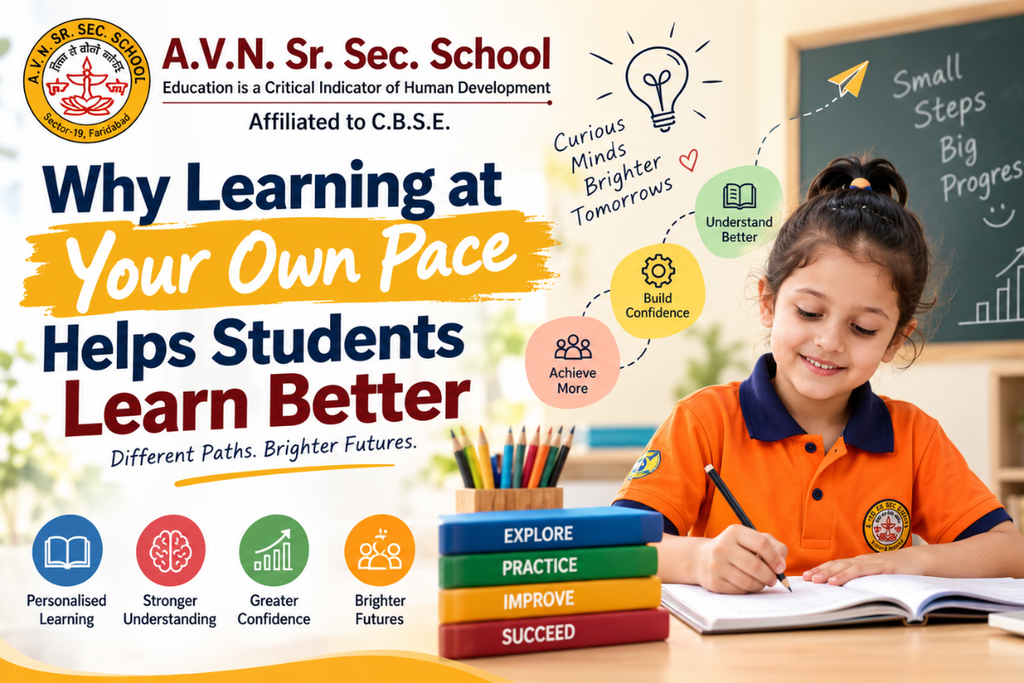
Every student learns differently. Some children understand a new concept after one explanation, while others need more examples, practice, or time before they feel confident. This difference is completely normal. However, traditional learning environments can sometimes make students feel that everyone should understand a lesson at exactly the same speed.
Learning at your own pace offers a different approach. It gives students enough time to understand difficult concepts while allowing them to move ahead when they are ready. Instead of focusing only on completing chapters quickly, self-paced learning focuses on genuine understanding.
For today’s students, this approach can make learning more comfortable, meaningful, and effective.
What Does Learning at Your Own Pace Mean?
Learning at your own pace does not mean that students can ignore deadlines or study whenever they want. Instead, it means giving students reasonable flexibility in how quickly they understand and practise a particular concept.
For example, one student may understand fractions quickly, while another may need additional examples and practice questions. A self-paced approach allows both students to continue learning without making either child feel inadequate.
The goal is not to make learning slower. The goal is to make learning better suited to the learner.
Every Student Has a Different Learning Speed
Children have different strengths, interests, experiences, and learning needs. A student who performs well in mathematics may need more time with language-based subjects. Another student may be highly creative but require additional practice with calculations.
Treating every student exactly the same does not always produce the same learning outcome.
When students are allowed some flexibility, they can spend more time on topics they find challenging and move through familiar concepts more efficiently. This can create a more balanced learning experience.
It also helps teachers identify where individual students need additional support.
Better Understanding Instead of Memorisation
One of the biggest advantages of self-paced learning is that it encourages students to focus on understanding rather than simply memorising information.
When students feel pressured to keep up with a fixed pace, they may memorise answers just to complete an assignment or prepare for a test. They might achieve a short-term result without developing a strong understanding of the concept.
Learning at a comfortable pace gives students an opportunity to:
- Read a concept again
- Ask questions
- Practise different examples
- Identify mistakes
- Connect new information with previous knowledge
- Apply what they have learned
This deeper understanding can help students remember concepts for longer and use their knowledge in new situations.
It Can Reduce Unnecessary Learning Pressure
Academic pressure can affect how students approach learning. When children constantly worry about falling behind their classmates, they may become hesitant to ask questions or admit that they do not understand something.
A supportive learning environment can change this experience.
When students know that needing additional time is acceptable, they are more likely to ask for help and continue practising. This can reduce the fear of making mistakes and encourage a healthier attitude toward learning.
However, self-paced learning should not mean removing all academic expectations. Students still need structure, regular practice, guidance, and clear goals. The difference is that they receive appropriate support while working toward those goals.
Self-Paced Learning Can Build Confidence
Confidence develops when students experience progress.
Imagine a child struggling with a mathematics topic. After receiving additional explanations and completing several practice exercises, the student finally understands it. That moment of achievement can create confidence.
Instead of thinking, “I am bad at mathematics,” the student begins to think, “I can understand this if I practise.”
This shift in mindset is important. Students learn that difficulty does not necessarily mean inability. Sometimes, they simply need more time, another explanation, or a different method of learning.
The Role of Teachers in Self-Paced Learning
Teachers remain extremely important in a self-paced learning environment. Technology and educational resources can provide flexibility, but students still need human guidance.
Teachers can observe how students respond to different activities and identify areas where they are struggling. They can provide additional explanations, create differentiated activities, encourage students, and challenge those who are ready to move further.
For example, a teacher may provide additional practice to one student while giving another student an advanced problem based on the same concept.
This creates a classroom where students can progress without losing the benefits of teacher interaction.
Technology Can Support Individual Learning
Digital technology has created new opportunities for personalised learning. Educational platforms, interactive exercises, digital libraries, recorded lessons, and educational applications can allow students to revisit concepts whenever necessary.
A student who does not understand a topic during the first lesson can review additional material later. Another student who understands the concept quickly can explore more challenging resources.
Technology therefore becomes a supporting tool rather than a replacement for teachers.
The most effective approach combines technology with classroom teaching, discussion, practical activities, and personal guidance.
Self-Paced Learning Encourages Students to Take Responsibility
When students have some control over their learning process, they gradually learn to take greater responsibility for their education.
They can begin asking themselves:
- What do I understand?
- Which topic do I need to practise?
- Where am I making mistakes?
- What should I revise?
- When should I ask for help?
These questions encourage self-awareness and independent learning.
Over time, students can become better at organising their study time and identifying their own strengths and weaknesses. These habits can become extremely useful when they enter higher education, where independent learning becomes increasingly important.
Learning at Your Own Pace Does Not Mean Learning Alone
There is an important difference between self-paced learning and learning without support.
Students still benefit from teachers, classmates, parents, discussions, group activities, and collaborative projects. Learning with others helps children develop communication and teamwork skills.
A balanced approach can allow students to work independently when they need focused practice while also giving them opportunities to collaborate and exchange ideas with classmates.
This combination can make learning both flexible and social.
How Schools Can Support Different Learning Needs
Schools can create a flexible learning environment through several practical methods. These may include differentiated classroom activities, revision resources, project-based learning, individual feedback, small-group support, educational technology, and opportunities for students to explore topics beyond the basic curriculum.
A supportive environment is particularly important because students should not feel defined by a single test, assignment, or academic result.
As one of the established Schools in Faridabad, AVN School can provide students with opportunities to learn through different methods while receiving guidance from teachers according to their learning needs.
A strong educational environment should recognise that academic development is not a race. Students need clear expectations, but they also need opportunities to understand concepts properly.
The Role of Parents in Supporting Self-Paced Learning
Parents can also encourage healthy learning habits at home. Instead of constantly asking children how much of the syllabus they have completed, parents can ask whether they understood what they studied.
Simple questions such as “What did you learn today?” or “Which part was difficult?” can encourage children to think about their learning process.
Parents can also provide a quiet study environment, encourage regular reading, allow sufficient practice time, and avoid comparing their child’s progress with that of other children.
Every child develops differently. Constructive support is generally more useful than constant comparison.
Preparing Students for Lifelong Learning
The ability to learn independently becomes increasingly important as students grow older. In college and professional life, nobody explains every concept at the same pace or provides answers to every question.
Students eventually need to research information, learn new skills, solve unfamiliar problems, and adapt to changing requirements.
A CBSE Affilated School in Faridabad can support this development by encouraging students to become active participants in their education rather than passive recipients of information.
Similarly, an English Medium School of Faridabad can provide students with access to a wide range of learning resources while helping them develop communication and academic skills needed for future opportunities.
Finding the Right Balance
Self-paced learning should not be treated as a complete replacement for structured classroom education. Students need routines, deadlines, curriculum goals, assessments, and teacher guidance.
The real value comes from finding the right balance.
Students should have clear learning objectives while receiving enough flexibility to revisit difficult concepts, practise important skills, and progress when they are ready.
This approach can make education more responsive to individual learning needs without removing structure.
Conclusion
Learning at your own pace can help students move beyond simply completing lessons and focus on actually understanding them. It can support confidence, reduce unnecessary pressure, encourage independent learning, and help children recognise that everyone develops skills at a different speed.
The purpose of education is not to make every student reach the same point at exactly the same time. It is to give every child the knowledge, skills, guidance, and confidence needed to keep progressing.
When schools, teachers, and parents create an environment where students can learn with the right balance of structure and flexibility, learning becomes more personal and meaningful.
Ultimately, the goal is simple: help students understand, practise, improve, and keep learning throughout life.