- Sector-19, Fridabad-121002, Haryana, India
- +91 129 403 7300
- +91 971 759 0012
- Info@avnschoolfaridabad.com
From Classrooms to Careers: How Top Schools Foster Logic

Celebrating Freedom, Excellence & Unity
August 20, 2026
What Is the 3C Curriculum? A Complete Guide for Parents
September 4, 2026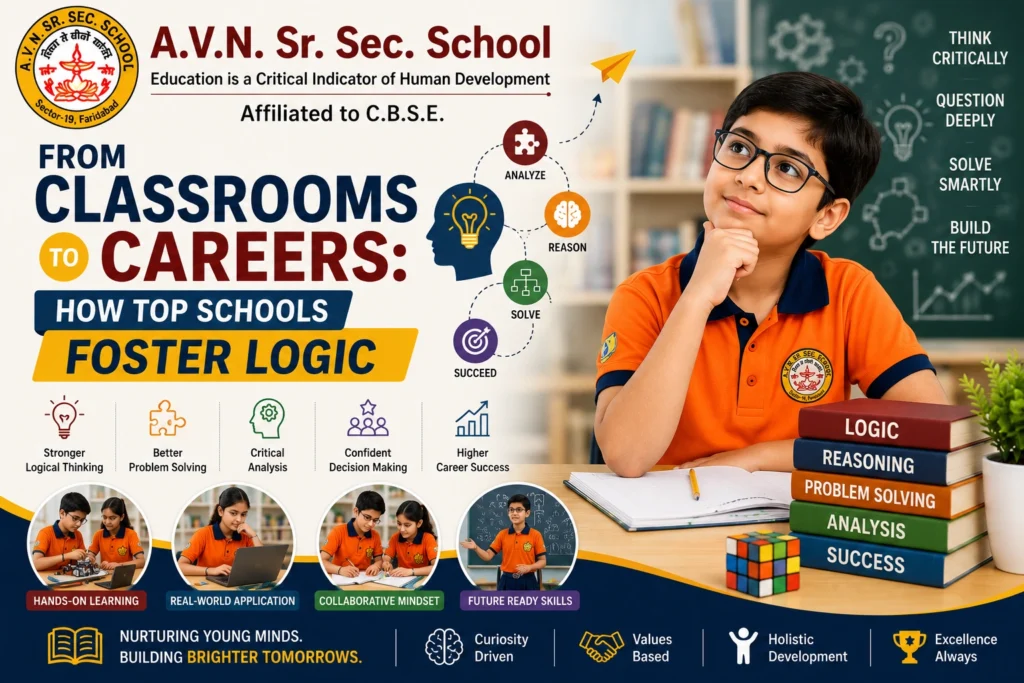
In an era dominated by rapid technological progress and complex global challenges, what is the single most valuable skill a student can carry into adulthood? While subject knowledge and factual recall remain important, they are no longer sufficient on their own. The modern world does not merely reward what you know; it rewards how you think.
At the center of sound decision-making, innovation, and career success lies logical reasoning—the ability to analyze information objectively, identify underlying patterns, evaluate arguments, and construct rational solutions. Far from being an innate talent that children either have or do not have, logical thinking is a cognitive muscle. When nurtured within the right educational framework, it grows stronger with practice.
Forward-thinking institutions understand this reality and actively design their learning environments to cultivate logical minds from the earliest grades through senior secondary school.
The Value of Logic: Beyond the Academic Exam
For many students, logic is introduced as a standalone chapter in a mathematics or reasoning workbook. However, true logical reasoning extends across every facet of life:
- Academic Mastery: Understanding cause-and-effect relationships allows students to grasp scientific principles, historical developments, and literary themes at a much deeper level than simple rote learning allows.
- Real-World Decision Making: From managing personal finances to evaluating news sources in a digital age, logical reasoning helps young adults filter out emotional bias and make grounded, rational choices.
- Career Adaptability: Industries are transforming rapidly due to automation and artificial intelligence. The professionals who thrive in tomorrow’s workplace will be those who can deconstruct unfamiliar problems, design strategic frameworks, and make sound judgments under ambiguity.
When students learn to think logically, they stop viewing education as a series of tests to pass and begin seeing it as a toolkit for navigating life.
How Leading Schools Build Logical Thinkers
Developing sharp analytical faculties does not happen by accident. It requires deliberate pedagogical strategies, modern infrastructure, and a culture that encourages curiosity. Here is how modern educational institutions foster critical and logical reasoning every day.
1. Moving from Memorization to Inquiry-Based Learning
Traditional education often focused on giving students answers to memorize. Progressive schools flip this model by giving students questions to explore.
Instead of presenting formulas and facts as rigid rules, educators guide students through inquiry-based discussions:
- Why did this historical event unfold the way it did?
- What variables caused the outcome of this science experiment to shift?
- How can this mathematical equation be solved using an alternative method?
By encouraging students to question assumptions and defend their hypotheses with evidence, schools help them build a systematic framework for analytical thought.
2. Hands-On STEM and Practical Application
Abstract theories become clear when students can test them with their own hands. Modern science laboratories, mathematics activity rooms, and robotics workshops serve as training grounds for logical reasoning.
When students write code to direct a robot, build working electrical circuits, or analyze chemical reactions, they engage directly with conditional logic (“If X happens, then Y will result”). When an experiment fails, they learn to troubleshoot methodically—isolating variables, identifying errors, and testing new solutions. This iterative process is the exact methodology utilized by top engineers, scientists, and business strategists.
3. Debate, Socratic Dialogue, and Perspective-Taking
Logic is not confined to the sciences. The humanities offer an equally fertile ground for sharpening the intellect. Through structured debates, Model United Nations (MUN) conferences, and Socratic seminars, students learn to:
- Construct well-reasoned, evidence-backed arguments.
- Identify logical fallacies in opposing viewpoints.
- Distinguish between objective facts and subjective opinions.
- Appreciate multiple perspectives on multifaceted social and ethical issues.
These exercises teach children how to express their ideas persuasively while remaining open to revising their conclusions when presented with better evidence.
The AVN Approach: Nurturing Analytical Excellence
Creating an environment where logic, creativity, and character thrive together requires institutional dedication and experienced mentorship. At A.V.N. Senior Secondary School (Sector-19, Faridabad), the curriculum is structured to ensure that academic rigor is paired with experiential, practical understanding.
When parents evaluate their options to find the best school environment in Faridabad for their children, they often look for this exact balance. AVN integrates these crucial experiential pedagogies across all age groups. From foundational activities in the primary wing that spark natural curiosity to advanced analytical projects in the senior secondary streams, students are consistently encouraged to think independently.
Furthermore, for families specifically dedicated to finding the best CBSE education in Faridabad, the institution stands out by seamlessly aligning its progressive methods with the latest National Education Policy (NEP) guidelines. This framework places a heavy emphasis on interdisciplinary thinking, logical reasoning, and 21st-century skill development—ensuring students are well-prepared for competitive exams, higher education, and fulfilling careers.
Practical Ways Parents Can Reinforce Logic at Home
While schools provide the structured foundation for logical thinking, parents play an equally vital role in reinforcing these habits at home. Here are simple, everyday ways to cultivate an analytical mindset:
- Ask Open-Ended Questions: Rather than providing direct answers immediately, ask questions like, “What do you think will happen next?” or “Why do you think that solution didn’t work?”
- Encourage Strategy Games: Board games such as chess, checkers, Scrabble, and strategic card games teach foresight, pattern recognition, and tactical planning in a fun setting.
- Involve Them in Everyday Problem Solving: Include your child in age-appropriate household decisions—such as comparing prices while grocery shopping, planning travel itineraries, or troubleshooting a simple household repair.
- Embrace Productive Failure: When a child makes a mistake or struggles with a problem, resist the urge to step in immediately. Encourage them to reflect on the process, adjust their strategy, and try again.
Preparing Students for a Fulfilling Future
The ultimate goal of education is not merely to prepare children for exams, but to prepare them for life. By equipping young learners with robust logical reasoning skills, schools and parents give them an enduring advantage that outlasts any specific syllabus or textbook.
When a student learns how to think clearly, assess situations rationally, and approach challenges with a problem-solving mindset, they gain the confidence to step into any professional arena and make a meaningful impact. The journey from the classroom to a successful career begins with the habits of mind nurtured today.
From Classrooms to Careers: How Top Schools Foster Logic
In an era dominated by rapid technological progress and complex global challenges, what is the single most valuable skill a student can carry into adulthood? While subject knowledge and factual recall remain important, they are no longer sufficient on their own. The modern world does not merely reward what you know; it rewards how you think.
At the center of sound decision-making, innovation, and career success lies logical reasoning—the ability to analyze information objectively, identify underlying patterns, evaluate arguments, and construct rational solutions. Far from being an innate talent that children either have or do not have, logical thinking is a cognitive muscle. When nurtured within the right educational framework, it grows stronger with practice.
Forward-thinking institutions understand this reality and actively design their learning environments to cultivate logical minds from the earliest grades through senior secondary school.
The Value of Logic: Beyond the Academic Exam
For many students, logic is introduced as a standalone chapter in a mathematics or reasoning workbook. However, true logical reasoning extends across every facet of life:
- Academic Mastery: Understanding cause-and-effect relationships allows students to grasp scientific principles, historical developments, and literary themes at a much deeper level than simple rote learning allows.
- Real-World Decision Making: From managing personal finances to evaluating news sources in a digital age, logical reasoning helps young adults filter out emotional bias and make grounded, rational choices.
- Career Adaptability: Industries are transforming rapidly due to automation and artificial intelligence. The professionals who thrive in tomorrow’s workplace will be those who can deconstruct unfamiliar problems, design strategic frameworks, and make sound judgments under ambiguity.
When students learn to think logically, they stop viewing education as a series of tests to pass and begin seeing it as a toolkit for navigating life.
How Leading Schools Build Logical Thinkers
Developing sharp analytical faculties does not happen by accident. It requires deliberate pedagogical strategies, modern infrastructure, and a culture that encourages curiosity. Here is how modern educational institutions foster critical and logical reasoning every day.
1. Moving from Memorization to Inquiry-Based Learning
Traditional education often focused on giving students answers to memorize. Progressive schools flip this model by giving students questions to explore.
Instead of presenting formulas and facts as rigid rules, educators guide students through inquiry-based discussions:
- Why did this historical event unfold the way it did?
- What variables caused the outcome of this science experiment to shift?
- How can this mathematical equation be solved using an alternative method?
By encouraging students to question assumptions and defend their hypotheses with evidence, schools help them build a systematic framework for analytical thought.
2. Hands-On STEM and Practical Application
Abstract theories become clear when students can test them with their own hands. Modern science laboratories, mathematics activity rooms, and robotics workshops serve as training grounds for logical reasoning.
When students write code to direct a robot, build working electrical circuits, or analyze chemical reactions, they engage directly with conditional logic (“If X happens, then Y will result”). When an experiment fails, they learn to troubleshoot methodically—isolating variables, identifying errors, and testing new solutions. This iterative process is the exact methodology utilized by top engineers, scientists, and business strategists.
3. Debate, Socratic Dialogue, and Perspective-Taking
Logic is not confined to the sciences. The humanities offer an equally fertile ground for sharpening the intellect. Through structured debates, Model United Nations (MUN) conferences, and Socratic seminars, students learn to:
- Construct well-reasoned, evidence-backed arguments.
- Identify logical fallacies in opposing viewpoints.
- Distinguish between objective facts and subjective opinions.
- Appreciate multiple perspectives on multifaceted social and ethical issues.
These exercises teach children how to express their ideas persuasively while remaining open to revising their conclusions when presented with better evidence.
The AVN Approach: Nurturing Analytical Excellence
Creating an environment where logic, creativity, and character thrive together requires institutional dedication and experienced mentorship. At A.V.N. Senior Secondary School (Sector-19, Faridabad), the curriculum is structured to ensure that academic rigor is paired with experiential, practical understanding.
When parents evaluate their options to find the best school environment in Faridabad for their children, they often look for this exact balance. AVN integrates these crucial experiential pedagogies across all age groups. From foundational activities in the primary wing that spark natural curiosity to advanced analytical projects in the senior secondary streams, students are consistently encouraged to think independently.
Furthermore, for families specifically dedicated to finding the best CBSE education in Faridabad, the institution stands out by seamlessly aligning its progressive methods with the latest National Education Policy (NEP) guidelines. This framework places a heavy emphasis on interdisciplinary thinking, logical reasoning, and 21st-century skill development—ensuring students are well-prepared for competitive exams, higher education, and fulfilling careers.
Practical Ways Parents Can Reinforce Logic at Home
While schools provide the structured foundation for logical thinking, parents play an equally vital role in reinforcing these habits at home. Here are simple, everyday ways to cultivate an analytical mindset:
- Ask Open-Ended Questions: Rather than providing direct answers immediately, ask questions like, “What do you think will happen next?” or “Why do you think that solution didn’t work?”
- Encourage Strategy Games: Board games such as chess, checkers, Scrabble, and strategic card games teach foresight, pattern recognition, and tactical planning in a fun setting.
- Involve Them in Everyday Problem Solving: Include your child in age-appropriate household decisions—such as comparing prices while grocery shopping, planning travel itineraries, or troubleshooting a simple household repair.
- Embrace Productive Failure: When a child makes a mistake or struggles with a problem, resist the urge to step in immediately. Encourage them to reflect on the process, adjust their strategy, and try again.
Preparing Students for a Fulfilling Future
The ultimate goal of education is not merely to prepare children for exams, but to prepare them for life. By equipping young learners with robust logical reasoning skills, schools and parents give them an enduring advantage that outlasts any specific syllabus or textbook.
When a student learns how to think clearly, assess situations rationally, and approach challenges with a problem-solving mindset, they gain the confidence to step into any professional arena and make a meaningful impact. The journey from the classroom to a successful career begins with the habits of mind nurtured today.