- Sector-19, Fridabad-121002, Haryana, India
- +91 129 403 7300
- +91 971 759 0012
- Info@avnschoolfaridabad.com
Beyond Academics: How Schools in Faridabad Prepare Students for Careers

A Proud Moment of Recognition & Gratitude
September 19, 2026
Exploring Psychology Through Interactive Learning
October 1, 2026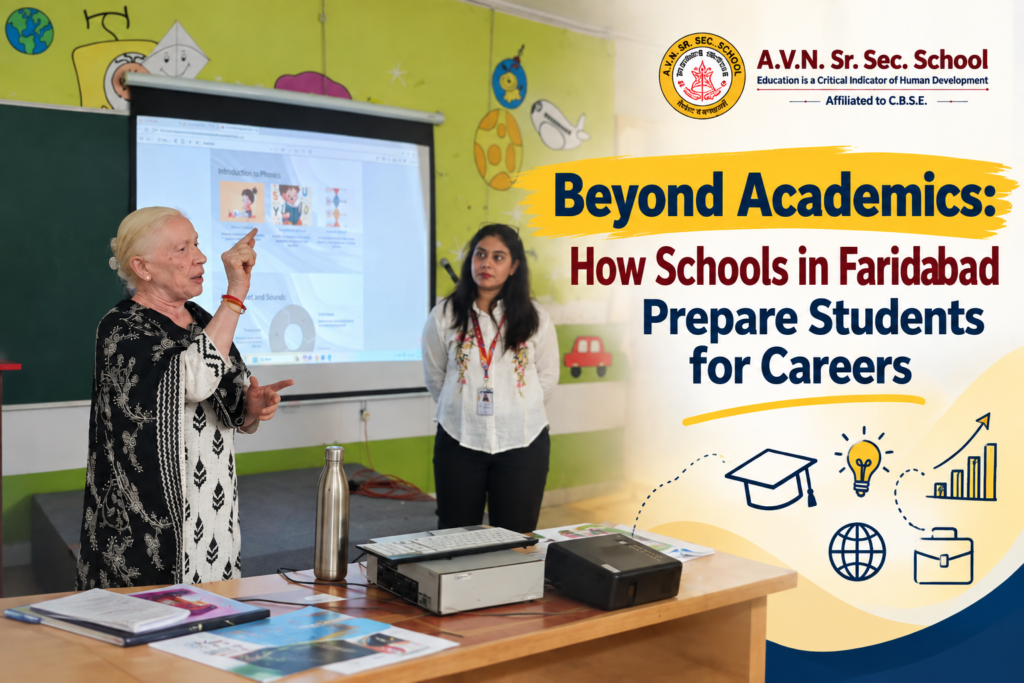
School education is no longer only about completing the syllabus, scoring good marks, and preparing for examinations. While academic knowledge remains important, students also need communication, problem-solving, creativity, teamwork, adaptability and digital skills to succeed in a changing professional world.
This is why modern Schools in Faridabad are increasingly focusing on overall student development. The goal is to help children become confident learners who can apply what they learn in real-life situations and gradually develop the skills needed for higher education and future careers.
Career preparation does not mean asking young students to choose a profession too early. Instead, it means giving them opportunities to understand their strengths, explore different interests and develop skills that will remain useful across different careers.
Academic Knowledge Is Still the Foundation
Strong academic learning continues to play an important role in career preparation. Mathematics develops logical thinking, science encourages observation and experimentation, languages improve communication, and social sciences help students understand people and society.
However, simply remembering information is not enough.
Students need to understand concepts and know how to use them. For example, mathematics becomes more meaningful when students use calculations to solve practical problems. Science becomes more interesting when students conduct experiments and observe how concepts work in real situations.
This combination of knowledge and application helps students develop a stronger foundation for future studies.
Communication Skills Build Career Confidence
Good communication is useful in almost every profession. Students may have excellent ideas, but they also need to explain those ideas clearly.
Schools can help students develop communication skills through classroom discussions, presentations, debates, storytelling, group activities and public speaking.
These activities encourage students to speak confidently, listen to others and organise their thoughts before presenting them.
Learning in an English Medium School of Faridabad can also provide students with regular opportunities to develop their English communication skills while continuing to build strong understanding across subjects.
Communication is not only about speaking English. It also includes listening, writing, questioning and expressing ideas respectfully.
Problem-Solving Is a Career-Ready Skill
Workplaces rarely provide people with problems that have only one obvious answer. Employees are often expected to understand a situation, identify possible solutions and decide what to do next.
Students can begin developing these abilities during school.
Teachers can give students practical problems, puzzles, projects, experiments and open-ended questions. Instead of immediately providing an answer, students can be encouraged to think about different possibilities.
For example, a science project about saving water can require students to identify a local problem, research possible solutions and present their recommendations. Such an activity combines research, creativity, teamwork and problem-solving.
These experiences help students understand that learning is not only about finding the correct answer. It is also about understanding how to reach a solution.
Creativity Helps Students Think Differently
Career opportunities continue to change with technology and innovation. As a result, students need the ability to think creatively and approach problems from different perspectives.
Creative activities such as art, writing, design, music, theatre, model-making and project work give students opportunities to experiment with ideas.
Creativity also has a place in academic subjects. A student can create a model to explain a science concept, develop a presentation for a history topic or find a new way to represent mathematical information.
When students are allowed to explore ideas instead of always following a fixed method, they can become more comfortable with experimentation and innovation.
Technology and Digital Skills Matter
Technology is now connected to almost every area of professional life. Students therefore need more than basic computer knowledge.
They should gradually learn how to search for reliable information, use digital tools responsibly, create presentations, collaborate online and understand basic digital safety.
Artificial intelligence is also becoming part of education and professional environments. Students need to understand that technology should support their thinking rather than replace it.
Learning how to check information, protect personal data and use digital tools responsibly can become an important part of career preparation.
Teamwork Teaches Students How to Work With Others
Most careers involve working with other people. Employees may work with colleagues, managers, clients or teams from different backgrounds.
Schools provide a natural environment for students to develop teamwork skills.
Group projects, sports, competitions, cultural activities and classroom assignments teach students how to share responsibilities and work towards a common goal.
Students may also learn that teamwork does not mean everyone has the same opinion. They need to listen to different viewpoints, discuss ideas and find practical ways to move forward.
These experiences can prepare students for collaborative environments in college and professional life.
Leadership Starts With Small Responsibilities
Leadership is not limited to becoming a school captain or class representative. Students can develop leadership through small responsibilities in everyday school life.
Organising an activity, leading a group project, helping classmates, participating in a school event or taking responsibility for a particular task can teach students how to make decisions and manage responsibilities.
A CBSE Affilated School in Faridabad can provide students with opportunities to participate in academic and co-curricular activities that encourage responsibility, discipline and independent thinking.
The objective should not be to make every student a leader in the same way. Instead, students should have opportunities to discover where they can contribute and gradually become more confident in taking responsibility.
Experiential Learning Connects Education With Real Life
One of the most effective ways to prepare students for the future is to connect classroom concepts with real-world situations.
Experiential learning can include projects, experiments, educational visits, practical activities, community-based activities and problem-solving exercises.
For example, students learning about entrepreneurship could create a simple business idea and calculate its cost. Students learning about environmental issues could conduct a waste audit at school. Students studying economics could examine how a local market operates.
These activities make learning more meaningful because students can see how knowledge is used outside textbooks.
Schools Can Help Students Discover Their Interests
Career preparation should not mean pushing every student towards the same definition of success.
Children have different abilities and interests. One student may enjoy science and technology, while another may be interested in writing, design, sports, business or social work.
Schools can help students explore these interests through clubs, competitions, workshops, career awareness activities and interactions with professionals.
This exposure can help students understand the variety of career possibilities available to them.
The role of the school is not to decide a child’s career. It is to provide enough exposure and guidance so that students can eventually make informed choices.
Emotional Skills Are Also Important for Future Success
Career success is not based only on academic qualifications and technical abilities. Students also need emotional and social skills.
They need to learn how to handle mistakes, accept feedback, manage pressure, communicate respectfully and continue working when something does not go according to plan.
Schools can support this development by creating classrooms where students feel comfortable asking questions and learning from mistakes.
A student who understands that mistakes are part of learning may become more willing to try new approaches and take on challenges.
Parents and Schools Have a Shared Role
Career readiness is not something that schools can develop alone. Parents also play an important role.
Instead of focusing only on marks, parents can encourage children to read, ask questions, participate in activities and explore their interests.
Conversations about careers should also focus on skills and interests rather than only on popular professions. Children need space to understand what they enjoy and where their strengths lie.
Schools and parents can work together to create an environment where academic achievement and personal development support each other.
Preparing Students for a Changing Future
The careers students eventually enter may look very different from the careers that exist today. Technology, artificial intelligence, changing industries and new forms of work are continuously influencing the professional world.
This makes adaptability an important part of education.
The purpose of a modern school is therefore not simply to prepare students for their first job. It is to help them develop the ability to keep learning throughout their lives.
For families looking at education options, the Schools in Faridabad landscape offers different approaches to academic and overall student development. Parents can look beyond examination results and consider how a school supports communication, creativity, problem-solving, technology awareness, teamwork and independent learning.
Conclusion
Career preparation begins long before a student enters a college or applies for a job. It starts with the habits, skills and attitudes developed during school years.
Academic knowledge provides the foundation, while communication, creativity, problem-solving, teamwork, leadership, digital literacy and adaptability help students apply that knowledge in the real world.
The best preparation is not about predicting exactly what career a child will choose. It is about helping students become curious, confident and capable learners who can adapt as opportunities change.
When schools move beyond academics and give students meaningful opportunities to explore, create, collaborate and solve problems, they help build a stronger foundation for whatever path students choose in the future.